
AI Training
What Is Vibe Coding? The Term, the Method, and Where It Breaks Down
Short answer
Vibe coding is building software by describing what you want in plain language and letting an AI model write the code. Andrej Karpathy named it in February 2025 and Collins Dictionary made it the Word of the Year for 2025. You still run, test and correct the result — what you stop doing is typing syntax, which makes judgement, not syntax, the skill that decides whether you ship anything.
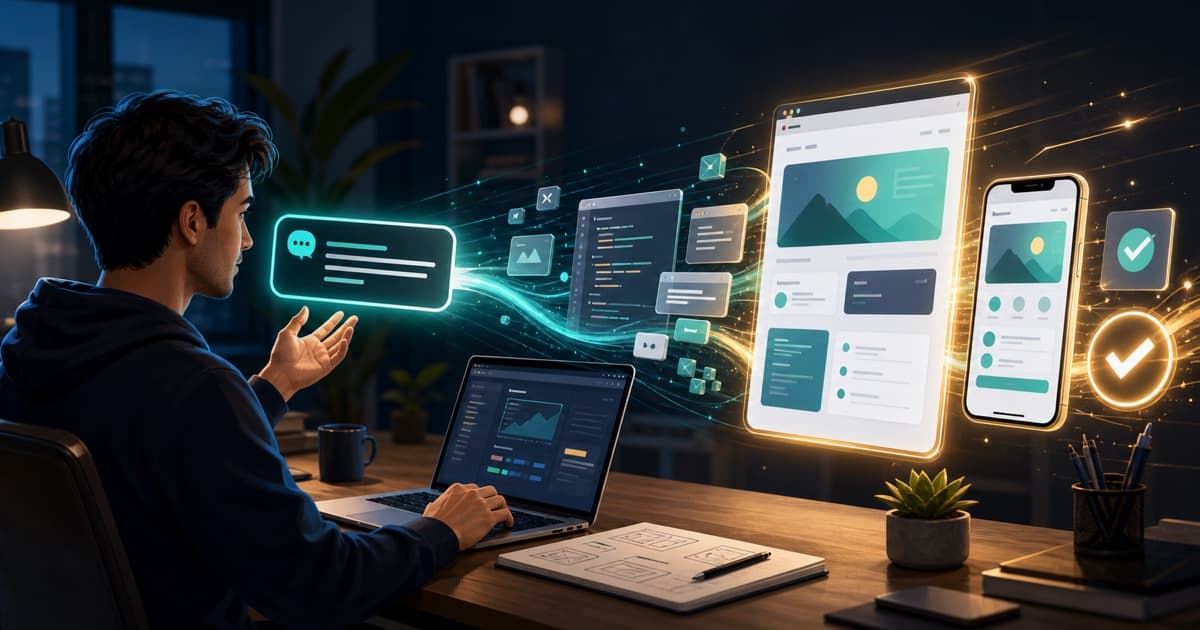
Vibe coding is building software by describing what you want in plain language and letting an AI model write the code. Collins Dictionary made it the Word of the Year for 2025, defining it as "the use of artificial intelligence prompted by natural language to write computer code." You still run it, test it and correct it — you just stop typing syntax.
Where the term came from
Andrej Karpathy — a founding member of OpenAI and formerly head of AI at Tesla — used the phrase in a post in February 2025. He was describing a loose way of working with AI coding tools: talk to the model, take what it gives you, run it, and let the code itself recede into the background instead of reading every line.
The phrase spread because it named something many people had already quietly started doing. Nine months later, in November 2025, Collins Dictionary named it Word of the Year, ahead of a shortlist that included clanker, broligarchy and aura farming. A half-joking post became a dictionary entry in under a year.
Why it is called "vibe" coding
The "vibe" is about what you hold in your head.
In traditional programming you carry the structure of the program with you: the syntax, the state, which function lives where, what breaks if you change this line. In vibe coding you hold the intent instead — what the thing should do, how it should behave, what "working" would look like — and let the model hold the rest.
So the vibe is not carelessness. It is a shift in what you pay attention to. You are steering by outcome rather than by implementation.
Is vibe coding actually programming?
This argument has not settled, and both sides are partly right.
It is not programming in the traditional sense. You are not writing syntax, and if you cannot read the output you cannot fully verify it. Experienced engineers are correct that someone who has only ever vibe coded will struggle the first time something fails in a way the model cannot diagnose for them.
But it is engineering in the sense that pays. You still decide what to build, break it into steps, define what correct behaviour looks like, test it, catch the model when it is confidently wrong, and get it deployed. Those were always the difficult parts. Typing was never the difficult part.
The most useful way to put it: vibe coding drives the cost of producing code towards zero, which makes judgement the scarce thing. Knowing what to build, and knowing whether it actually works, is now most of the job.
"White coding" — if that is what you searched for
A surprising number of people search for "white coding", or ask whether the term is "white coding or vibe coding".
There is no such thing as white coding. It is a mishearing. "Vibe" is easy to lose in a fast sentence or an unfamiliar accent, and autocorrect finishes the job. If you arrived here from that search, vibe coding is the term you were looking for.
What people actually build this way
Not toy examples — things people are shipping:
- Internal tools. The small ugly thing your business needs and no vendor sells: a stock checker, a shift roster, a quotation calculator.
- WhatsApp and web agents. A bot that answers customer questions, takes bookings, or passes an order to the kitchen.
- Landing pages and micro-sites that need to exist this week, not next quarter.
- Data work. Cleaning a messy spreadsheet, reconciling two exports, pulling a report that would take a day by hand.
- Prototypes built to be argued about and thrown away, which is where vibe coding is least risky and most useful.
The pattern: high value, small blast radius, and a human who can tell whether the output is right. When one of these is given a single job, a memory and a channel customers already use, it stops being a script and becomes an AI employee.
What you actually need to start
People search for the best language, the best platform, the best computer, the best AI for vibe coding. The honest answers are duller than the question implies.
Language: you do not pick one. The model picks, and it will usually reach for JavaScript/TypeScript or Python because that is what it has seen most of. You do not need to know either to begin, though you will absorb some as you go.
Tool: Claude Code, Cursor and similar agentic coding tools are the current serious options. They differ mainly in how much of your project the model can see and change at once.
Computer: any modern laptop. The model runs on someone else's servers, not yours. A faster machine will not make the code better. This is the question we are asked most often, and the answer disappoints people who were hoping to buy their way in.
The real requirement is none of the above. It is the ability to describe precisely what you want and to tell whether you got it. That is a language and testing skill, not a hardware or a syntax one.
How vibe coding actually works
The loop is always the same five moves:
- Describe. Say what you want in specific terms. "A form that takes a name and a phone number and sends it to WhatsApp" beats "a contact page".
- Generate. The model writes the code and, with agentic tools, creates the files and runs the commands itself.
- Run. Execute it. This step is not optional and it is where most beginners cheat.
- Observe. Look at what actually happened versus what you asked for. Read the error message properly rather than pasting it back immediately.
- Correct. Feed back the specific gap. "It saves the name but the phone number arrives empty" gets you further than "it doesn't work".
Almost everyone who struggles with vibe coding is skipping step 3 or step 4. The people who get good at it are the ones who test aggressively and describe failures precisely.
Where vibe coding breaks down
An honest list, because most articles on this stop at the good part:
- You accumulate code you do not understand. Fine at 200 lines. Painful at 5,000, when something breaks and you cannot form a hypothesis about why.
- Security is the weak point. Models will happily write code that exposes a key, trusts user input, or leaves a database open. They are not being careless — they are answering the question you asked, and you did not ask about security.
- The last stretch is the hard one. Getting to roughly working is fast. Getting from roughly working to genuinely reliable — edge cases, errors, real users doing unexpected things — is where the time goes, and where the model helps least.
- Confident wrongness. The model does not signal doubt the way a colleague would. It will produce a plausible, well-formatted, wrong answer with no change in tone.
- It does not replace understanding — it changes what you need to understand. You can stop learning syntax. You cannot stop learning how systems fail.
None of this makes vibe coding a toy. It makes it a tool with a shape, and knowing the shape is what separates people who ship from people who produce demos.
So is it worth learning?
If you want to build things and do not have a coding background, this is the most direct route that has ever existed. A year ago the honest advice was to learn Python first. That advice is now out of date for most practical purposes.
If you already write code, it changes what your day looks like rather than removing the need for you. You spend less time producing and more time specifying, reviewing and deciding.
Either way, the skill that carries is not the tool. It is being able to say exactly what you want, and to tell the difference between something that runs and something that works.
Ready to build AI agents yourself?
DSP AI Agent Mastery — self-paced, 16 modules, starts from zero.
Start AI Agent Mastery →