
AI Fundamentals
Machine Learning vs. Deep Learning vs. AI: What's the Difference?
Short answer
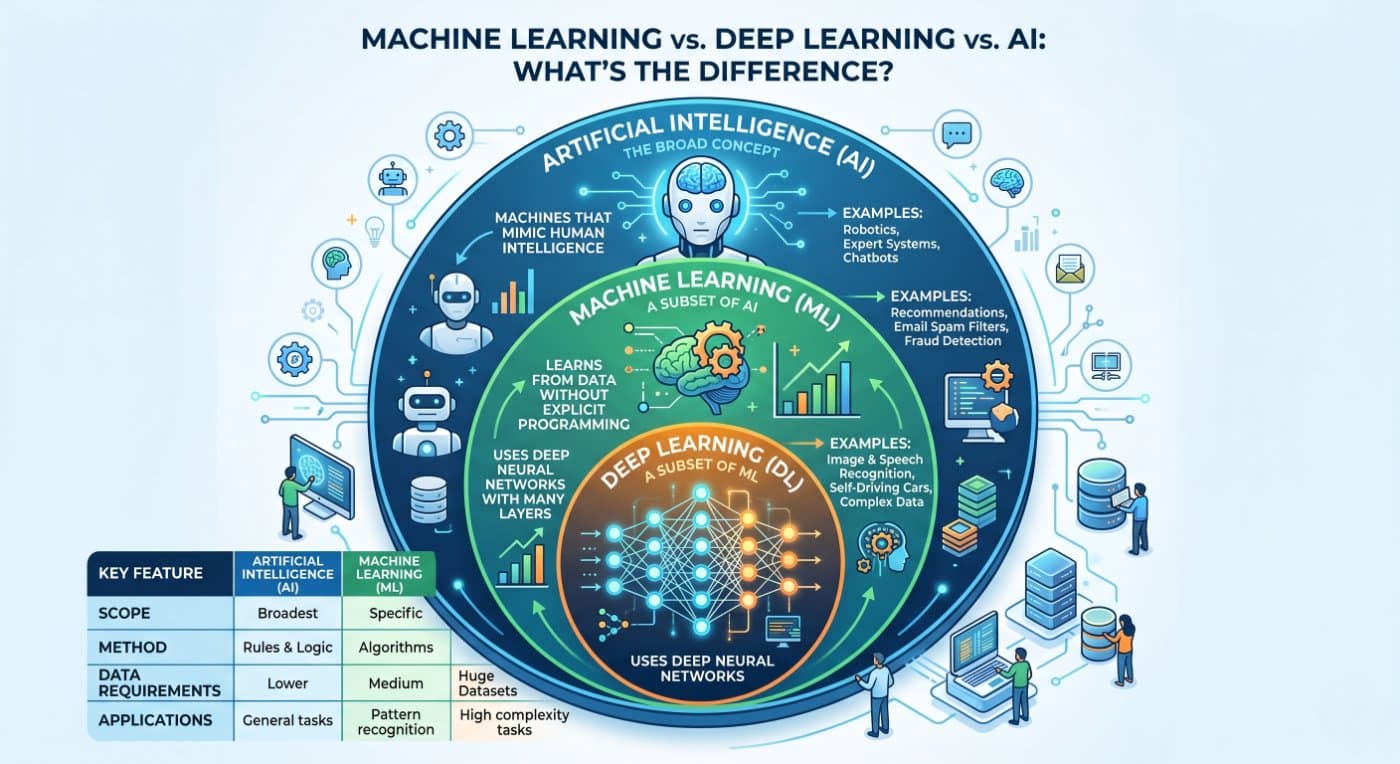
The three terms are nested. Artificial intelligence is any technique that lets a machine mimic human intelligence, hand-written rules included. Machine learning is the subset that learns the rules from data instead of being given them. Deep learning is the subset of machine learning built on many-layered neural networks — and generative AI sits inside deep learning.
Three words, three nested things
Artificial intelligence, machine learning, deep learning. The three terms dominate every AI conversation and they get swapped around freely, sometimes by people who should know better. They are not synonyms. They describe three nested ideas, each narrower than the one before, and generative AI sits inside the narrowest of them.
Think of nesting dolls. AI is the outer one. Machine learning fits inside it. Deep learning fits inside that. The language models everybody is using in 2026 are a kind of deep learning, which is a kind of machine learning, which is a kind of AI. Getting this straight is worth ten minutes, because when a vendor says "our AI system" the useful question is which doll they mean — and the answer tells you most of what you need to know about what it can and cannot do.
Artificial intelligence: the whole umbrella
AI covers any technique that lets a machine do something we would call intelligent. That includes things with no learning in them at all: hand-written if-then rules, search algorithms like the one finding your route in Google Maps, the logic in a chess engine.
Early AI was almost entirely this. Programmers wrote thousands of explicit instructions by hand, and the results were genuinely useful inside their boundaries and hopeless a step outside them. A system that knows nine hundred rules about tax knows nothing about the nine hundred and first case. That brittleness is the defining property of rule-based AI, and it is why the field kept hitting walls for forty years.
Machine learning: learning the rules instead of being given them
Machine learning inverted the approach. Rather than writing the rules, you supply a great deal of data and let the system work the rules out for itself.
A spam filter is the clean example. The rule-based version gets a list of forbidden phrases and fails the moment spammers change wording. The machine-learning version is shown millions of spam emails and millions of legitimate ones, and it derives the patterns itself — including patterns no human would have thought to write down. That is why it keeps working when the spam changes.
Most machine learning is not neural networks. Decision trees, random forests, support vector machines, plain linear regression — these are the workhorses, they are decades old, and for structured data in rows and columns they are often better than anything fancier. A great deal of real, profitable machine learning in banks and logistics companies is a regression model that nobody writes a press release about.
Deep learning: many layers, and why 2012 mattered
Deep learning is machine learning built on artificial neural networks — layers of interconnected nodes, loosely inspired by brains. "Deep" just means many layers.
What the layers buy you is abstraction that builds on itself. Shown photographs, the early layers learn to spot edges, the middle layers assemble edges into shapes, and the deepest layers recognise faces. Nobody programs that hierarchy; it falls out of the training. The same principle applied to text is what produces a model with a usable sense of grammar, tone and argument.
Deep learning was a research curiosity until 2012, when a network called AlexNet, from Geoffrey Hinton's group, entered the ImageNet visual recognition contest and cut the error rate by close to half. That result settled a long argument: given enough data and enough compute, these networks worked. Everything since — image recognition, speech-to-text, translation, and the language models — runs on that bet.
Generative AI, and where language models sit
Generative AI is the subset of deep learning that produces new material rather than sorting, scoring or predicting existing material. A model that labels an email as spam is not generative. A model that writes the email is.
So the full nesting reads: artificial intelligence, then machine learning, then deep learning, then generative AI, and inside that the large language models — ChatGPT, Claude, Gemini — that most people now mean when they say "AI". It is the most visible frontier of a sixty-year-old field, and it is a narrow slice of it.
What a large language model actually does
Underneath the essays and the code and the conversation, a language model performs exactly one operation: it predicts which token comes next in a sequence. A token is roughly a word or a piece of one. That is the whole trick, performed billions of times.
You already do this. Read "the capital of France is" and your mind supplies Paris before you decide to. Not because you looked it up, but because you have met that association in thousands of sentences. A language model does the same thing, having processed hundreds of billions of words from the web, books, papers and code repositories instead of a few thousand books.
Everything else is emergent. Ask it to write a business plan and it is still only choosing likely next tokens; it is just that "likely, given a request for a business plan" turns out to look a great deal like a business plan. This is the single most useful fact to hold on to, because it explains both the range and the failure modes.
How it learns, and what attention changed
Training is a loop of humbling simplicity. Show the model text. Let it predict the next token. Check the answer. Nudge its internal numbers — the weights, also called parameters — very slightly toward being right next time. Repeat across the whole dataset, an enormous number of times. What emerges is a dense internal representation of language, facts, reasoning patterns and a fair amount of common sense, none of which anyone wrote down.
Scale matters: GPT-3 had 175 billion parameters, and the models that followed are considerably larger, though the vendors mostly stopped publishing the figures. More parameters generally means more capacity for complex patterns. It is not the only thing that matters, and "bigger" has never been a guarantee of "better".
The architectural unlock was the Transformer, published by Google researchers in 2017 under the title "Attention Is All You Need". Its central mechanism, self-attention, lets the model weigh every word in a passage against every other to work out what relates to what. In "the bank refused the loan because it was already overextended", attention is what establishes that "it" is the bank and not the loan. That sensitivity to context is why current models read as coherent where earlier ones read as word salad.
Why it sounds certain when it is wrong
Language models produce confident, fluent, entirely false statements. The polite word is hallucination and the mechanism is not mysterious: the model is optimised to produce plausible text, not verified text. It holds no database of checked facts, has no way to look up whether its own output is true, and — unless it has been specifically trained toward it — no real notion of "I do not know".
A model is not a reference work. It is a model of language, extremely good at generating what reads like the right answer. That is the source of both its usefulness and its danger, and it is why anything that matters gets verified. It is also why giving a model real tools — search, a database, your own documents — changes the picture so much: the point of tools is to replace recall with retrieval. That is the bridge from a model to an actual AI agent.
What makes one model better than another
Four things, roughly in this order: the size and quality of the training data, the scale of the model, the care taken over the training process, and the fine-tuning and safety work done afterwards. That last stage is underrated and does much of the work you actually notice. Reinforcement learning from human feedback — human raters scoring outputs, the model learning from those preferences — is why Claude, ChatGPT and Gemini have distinct personalities and different refusal behaviour despite resting on much the same science.
Which is also why the practical skill is not picking the cleverest model. It is writing instructions a model can follow. Same model, different brief, wildly different output — the case made in writing effective AI prompts.
How the field actually got here
The story is not a rising line. It is two collapses and a very sudden ascent.
- 1950. Alan Turing asks whether machines can think, and proposes the test that carries his name: a machine indistinguishable from a person in conversation.
- 1956. The Dartmouth Conference — McCarthy, Minsky, Shannon, Rochester — founds AI as a discipline. Many attendees expect human-level intelligence within twenty years.
- 1960s–70s: the first winter. Programs that played checkers and proved theorems fell apart on anything ambiguous. Compute was thin, data was scarce, the promises had been extravagant. Funding stopped.
- 1980s: expert systems, then the second winter. Billions went into encoding specialists' knowledge as rules. The systems were costly, brittle and unscalable, and by the late eighties the money had gone again.
- 1997 and 2002. Quiet progress: Deep Blue beats Garry Kasparov at chess; the Roomba becomes the first autonomous robot anyone actually buys. Meanwhile the internet accumulates data and graphics cards get fast.
- 2012. AlexNet wins ImageNet and the deep learning era starts in earnest.
- 2016. AlphaGo beats Lee Sedol at Go, a game long held to be out of reach.
- 2017. The Transformer paper. Everything that follows is built on it.
- 2020. GPT-3 shows that one large model can write, reason and generalise across tasks it was never specifically trained for.
- 2022. ChatGPT launches and is reported to reach a hundred million users inside two months.
- 2024–26. Agentic AI reaches production: models that browse, write and run code, handle files and complete multi-step jobs without a human prompting each step.
Two winters in seventy years is worth remembering when you read a forecast. The field has a long record of overpromising, and a shorter, more recent record of delivering things that were supposed to be decades away.
Why keeping the distinction straight pays
It is not pedantry. Whether a system is hand-written rules, a traditional machine-learning model or a deep-learning model tells you where it will break, how much data it needed, whether anyone can explain its decisions, and how much to trust it unsupervised. "AI-powered" on a pricing page tells you nothing at all.
If you want the practical end of this — not the taxonomy but building something that runs — the six-stage route is set out in how to learn AI agents in Pakistan, and it starts with one agent doing one job.
Ready to build AI agents yourself?
DSP AI Agent Mastery — self-paced, 16 modules, starts from zero.
Start AI Agent Mastery →