
Agentic AI
Multi-Agent Systems: When AIs Work as a Team
Short answer
A multi-agent system is a team of AI agents working on one goal: an orchestrator agent breaks the goal into sub-tasks, hands each to a specialist agent with its own tools and knowledge, then synthesises what comes back. It exists because one agent has a finite context window and cannot specialise deeply in every domain at once.
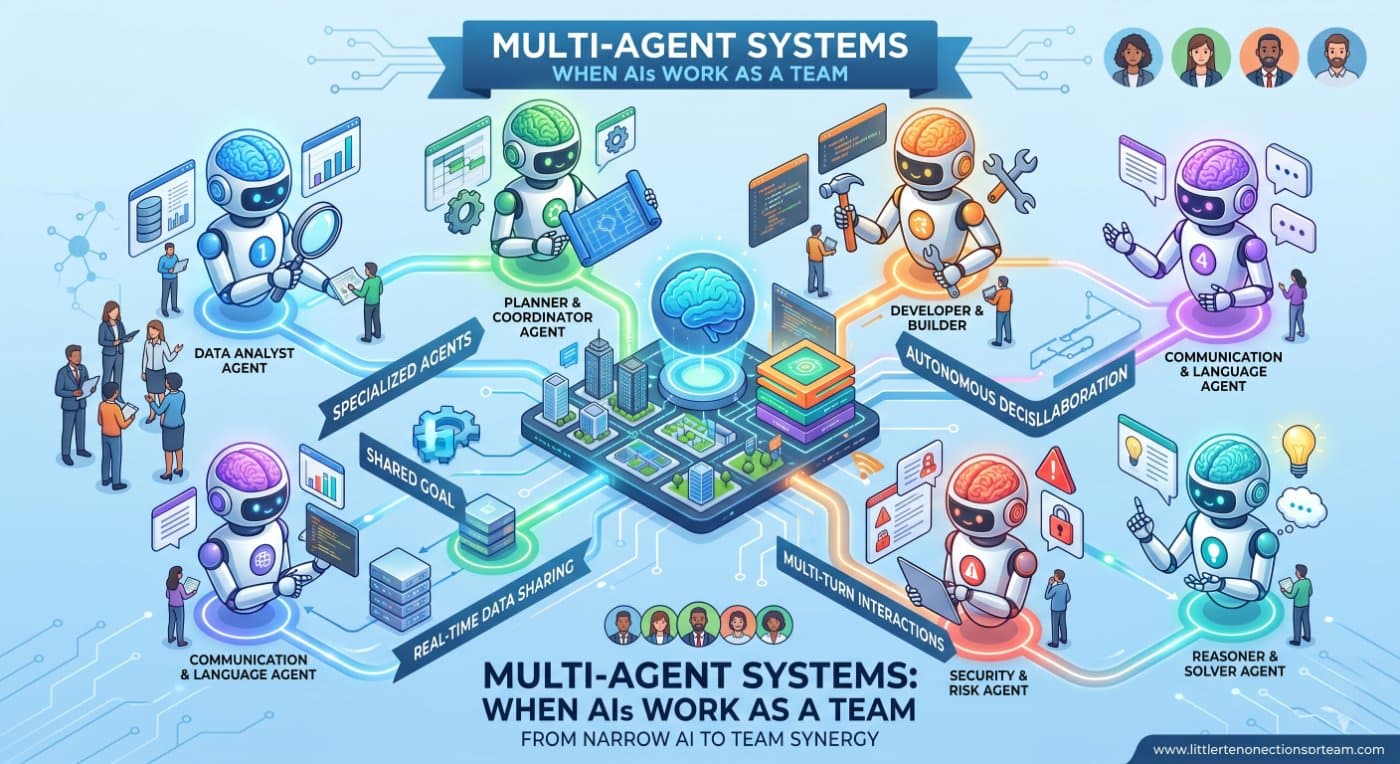
A single AI agent is impressive. But what happens when you build a team of agents — each specialised, each with different tools and knowledge, coordinated by an orchestrating agent? What you get is a multi-agent system: one of the most powerful architectures in modern AI, and the direction in which the whole field is moving.
The idea is older than the current wave of models. What changed is that the individual agent finally became good enough to be worth managing, which turned coordination from an academic problem into an engineering one.
Why one agent is not always enough
A single agent faces inherent limits. Its context window — how much it can hold in mind at once — is finite. It cannot specialise deeply in many domains simultaneously. And on long, complex tasks it drifts, losing track of earlier context and of its own original instruction. Just as no single person is a world-class researcher, writer, programmer and designer at the same time, one agent tends to perform every part of a complex project slightly worse than a focused one would.
Three failure modes show up again and again once a job gets big enough:
- The job description bloats. Every new responsibility adds rules, and rules interact. Past a certain size the instructions start contradicting each other, and the model quietly picks whichever it noticed last.
- Too many tools. Give one agent twenty tools and it will choose the wrong one at the wrong moment. Give it four and it rarely does.
- Context runs out at the worst time. The interesting work happens at step forty, which is exactly where the early context — the actual goal — has been squeezed out of the window.
If those sound familiar from a single agent you have already built, that is the signal. A multi-agent system is what you reach for when one agent has genuinely hit a ceiling — not before. (If you are still deciding what an agent even is, start with what an AI agent is, and why chatbots are not agents.)
The multi-agent architecture
Multi-agent systems solve this by dividing labour. An orchestrator agent receives the high-level goal and breaks it into sub-tasks. It assigns each sub-task to a specialist agent designed for that specific function. The specialists work independently, using their own dedicated tools and domain knowledge, then report results back to the orchestrator, which synthesises them and moves to the next phase.
Example. A market research system might include a Research Agent that searches the web and reads reports, a Data Agent that structures findings into spreadsheets, an Analysis Agent that identifies trends, and a Writing Agent that composes the final report — all coordinated by an orchestrator that manages the workflow from goal to polished deliverable.
The important detail is that each specialist has its own context, its own instructions and its own small set of tools. That is where the gain comes from. Nobody is holding the whole project in one head.
Four patterns you will actually use
Almost every working system is one of these four, or a combination:
- Orchestrator and workers. One agent plans and delegates; specialists execute and report back. The default, and the right first choice for anything where the sub-tasks are not known until the work starts.
- A pipeline. Fixed stages in a fixed order, each agent handing its output to the next: draft, then edit, then fact-check, then format. Predictable, cheap to debug, and the correct answer whenever the steps never change.
- Parallel fan-out with a synthesiser. Several agents attack the same question independently — three researchers on three sources — and a final agent reconciles what came back. Fast, and useful precisely because the disagreements are informative.
- Worker and critic. One agent produces, a second evaluates against written criteria and sends it back with specific objections. Two or three rounds of this beats one agent trying to grade its own homework, which models are famously bad at.
Choosing the pattern is most of the design work. Choosing the model is almost none of it.
Agent communication and trust
Agents in a multi-agent system communicate through structured messages. The orchestrator sends instructions; specialists send results. In practice the most valuable discipline here is boring: define the shape of those messages in advance — what a task looks like, what a result looks like, what a failure looks like — so a specialist that cannot finish says so in a form the orchestrator can act on, instead of returning a paragraph of apology that the next agent then treats as data.
A harder design question is trust. Should a specialist blindly follow every orchestrator instruction, or apply its own safety checks? The emerging consensus is that every agent in a system keeps its own guardrails — it cannot simply defer to another agent that claims authority. This is not paranoia about robots. It is the practical consequence of the fact that instructions inside a multi-agent system can originate from a web page one of the agents just read, and a message that arrives wearing the orchestrator’s voice is still only a message.
Two rules follow from that, and they are cheap to implement:
- Least privilege. The agent that drafts an email does not need the ability to send money. Scope each specialist’s tools to its own job.
- Log every handoff. When the output is wrong, the question is always which agent was wrong, and you cannot answer that from the final answer alone.
Real-world applications
Multi-agent systems are already deployed in software development (a coding agent, a testing agent and a documentation agent), in content production (research, writing, editing and SEO agents), in customer service (a triage agent routing to specialists for different product lines), and in scientific research (literature review, hypothesis generation and experimental design agents).
The business version is less exotic and easier to sell. A company that puts a sales agent, a support agent and a booking agent on one WhatsApp number has built a multi-agent system, whether or not anyone calls it that: an incoming message is classified, routed to whichever agent owns that job, and escalated to a human when it belongs to one. That is exactly how DSP’s AI Employees are deployed for clients — separate job descriptions, separate knowledge, one number the customer sees.
"Multi-agent systems are the organizational breakthrough that allows AI to tackle projects of human-organizational complexity — with the speed and scale that only machines can provide."
What a multi-agent system costs you
The honest trade-off, which the enthusiasm usually skips:
- Tokens multiply. Every handoff re-sends context. An orchestrator with four specialists can burn several times the tokens of one agent doing a slightly worse job — and you pay for the coordination, not just the work.
- Latency adds up. Sequential agents wait on each other. A pipeline of five stages is five round trips before the user sees anything.
- Debugging gets harder. A wrong answer from one agent is easy to inspect. A wrong answer produced by five agents, where agent two misread agent one and agent four papered over it, is a genuinely difficult afternoon.
- Failure compounds. Five steps that are each 95% reliable are not 95% reliable together. Reliability is where multi-agent systems actually die, not capability.
When not to build one
Do not start here. Build one agent, give it one job, and push it until it visibly fails — then split it along the line where it failed. Most jobs that look like they need a team need a better job description or the right rung of the memory ladder instead, and both are an afternoon rather than a rebuild.
The test worth applying: can you name the sub-tasks, and would a different human do each of them? If yes, split. If you are splitting because it sounds more advanced, you are buying cost and latency and getting nothing back.
How to build your first one
A first multi-agent system, in the order that works:
- Write the goal as one sentence — what goes in, what comes out, what "done" looks like.
- List the sub-tasks and give each one an owner, a small tool set and its own written job description.
- Fix the message format between them before you write any logic. Task in, result or failure out.
- Run the pipeline by hand first — you as the orchestrator, pasting between agents. If it does not work manually, no framework will save it.
- Then automate the orchestrator, and log every handoff from the first run.
The productivity multiplier over single-agent systems — let alone over human teams doing the same coordination — is substantial. So is the number of ways it can go wrong. Both facts are the reason the architecture is worth learning properly rather than copying from a diagram.
Ready to build AI agents yourself?
DSP AI Agent Mastery — self-paced, 16 modules, starts from zero.
Start AI Agent Mastery →