
AI for Business
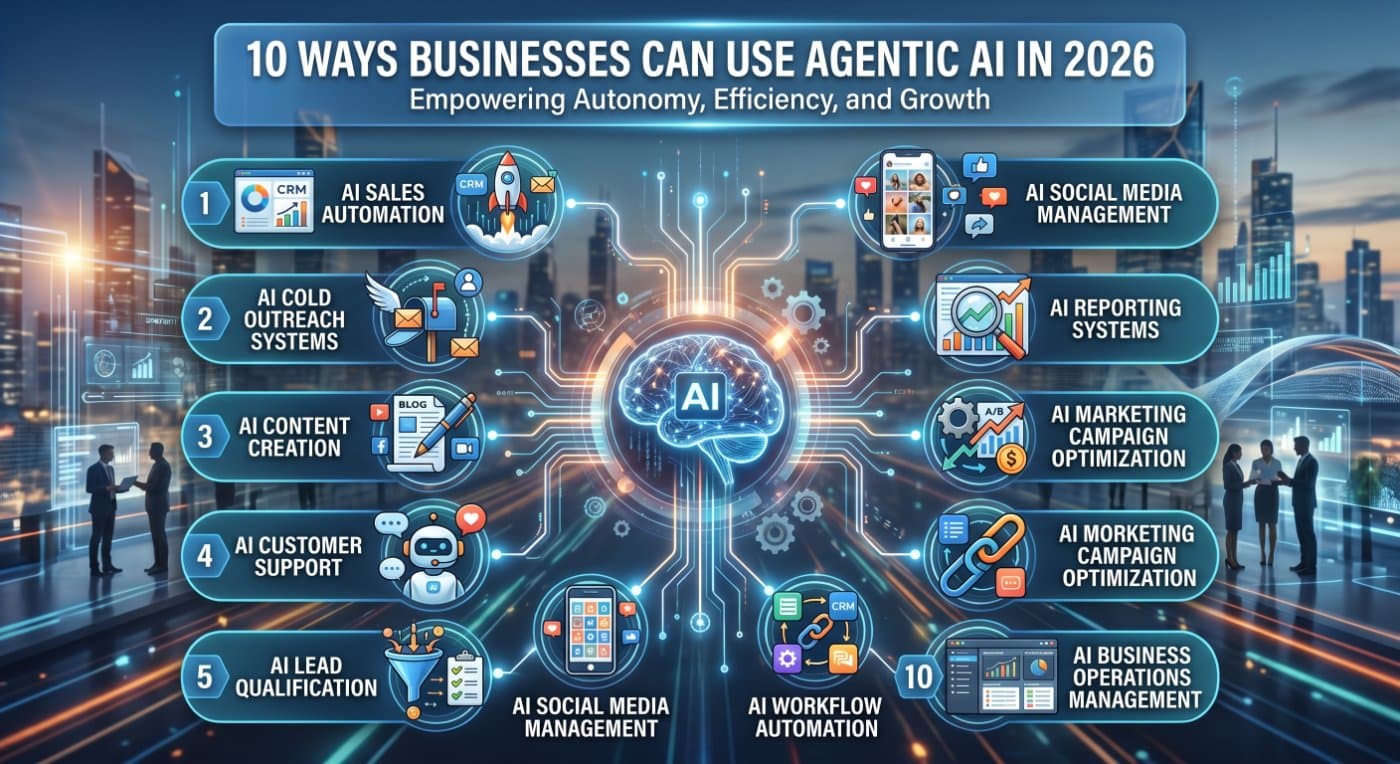
10 Ways Businesses Can Use Agentic AI in 2026
Short answer
Businesses use agentic AI most profitably on repetitive, measurable work: answering and qualifying inbound leads, triaging support, taking bookings, chasing follow-ups, watching competitors and closing the monthly books. The job worth automating first is the dull one you repeat forty times a week, not the most impressive one.
From assisting to operating
For most of the last three years AI in business meant a person with a chat window open, writing things faster. Useful, and it changed nobody's org chart. What changed in 2026 is that agents started doing the work rather than helping with it — taking a goal, using the company's own tools, and finishing a job while nobody watched.
That distinction matters commercially, because the second kind removes a task from someone's day instead of speeding it up. Below is what businesses are actually running, then the things that go wrong, which is the part most write-ups leave out.
Ten jobs agentic AI is doing in businesses right now
None of these is speculative and none needs a bespoke build:
- Answering and qualifying inbound leads. An agent replies to every enquiry on WhatsApp, the website or email within seconds, asks the two or three questions that separate a real buyer from a browser, and writes the result to the CRM. This is the most common first agent, for the reason set out in why sales is the first job AI is replacing: the cost of a slow reply is measurable.
- Support triage. It reads incoming tickets, classifies by urgency and type, answers the recurring ones from your own documentation, escalates the rest to a human with the history attached, and logs everything. Intercom and Zendesk ship this natively now, so for many businesses it is configuration rather than a build.
- Booking and scheduling. Taking the appointment, writing it to the calendar, sending the reminder, handling the reschedule. Dull, constant, and the thing a restaurant or clinic loses money on every evening it goes unanswered.
- Cold outreach at a volume a person cannot match. Researching a target list, personalising each message from something real and recent, sending, tracking replies, queueing the interested ones for a human. The failure mode is common: volume without personalisation is spam, and it burns the list.
- Competitive intelligence. An agent watches competitors' sites, pricing pages, press releases and social accounts on a schedule, flags what changed and summarises it weekly. Nobody was doing this manually anyway, which makes it gain rather than replacement.
- Meeting follow-up. Transcribe, extract the action items, assign them, create the tasks in whatever tracker you use, send the recap — inside a few minutes of the call ending, while people still care.
- Content production. Ideas against your actual search strategy, drafts, a check against brand guidelines, scheduling. This is where a multi-agent setup earns its complexity, because drafting and editing are genuinely different jobs with different instructions.
- Financial reporting. Pull from the accounting system, generate the monthly pack, flag the anomalies — the unusual expense, the revenue dip, the cash-flow squeeze — and format it for the people who read it.
- CV screening. Score applications against the criteria actually in the job description, summarise the shortlist, draft the first approach to the strongest candidates. Days of reading compressed to hours. Also the item here with the sharpest bias risk, so it is the one that needs a human signing off the shortlist.
- Operational glue. Data entry, invoice processing, file management, the internal notifications nobody remembers to send. Individually trivial, collectively a part-time job.
Read that list looking for your own most expensive repeated hour, not for the most impressive item. The one worth building is the boring one you do forty times a week.
You do not need a tech team to start
The idea that this is enterprise territory — data science teams, six-figure software contracts — stopped being true several years ago. The same frontier models a bank uses are available to a sole trader in Lahore or a restaurant owner in Peshawar for a few dollars a month.
What a one-person business can do this week, with no code: draft the month's marketing content and refine it rather than writing from scratch; configure a support chatbot in Tidio or Chatbase against your own FAQ; upload the sales spreadsheet and ask for the trends, the anomalies and a projection, which used to mean hiring a consultant; use the model as a thinking partner for a business plan or a competitive review.
The real barrier was never technology and is not price. It is habit. The owners who get value from this are the ones who open the model the way they open email — reaching for it by reflex whenever a task involves writing, analysis or a decision. The ones who don't have the same subscription sitting unused.
What it looks like when operations run themselves
Take one order, processed the old way. A staff member reads it, checks stock by hand, updates the system, writes the confirmation, tells the shipping team, then chases the status when the customer asks. Six steps, each waiting on somebody being at their desk.
The same order with agents in the loop: it arrives, stock is checked instantly, records update, the confirmation goes out, shipping is scheduled, tracking updates send themselves. The customer experience is not merely faster — it is identical at 2am and on Eid, which the human version never is.
Multiply that across a company and the operating characteristics change rather than improve. Execution moves from batch to real time. Capacity stops being a function of headcount. Repetitive work stops generating the errors that come from doing it for the fortieth time that day.
Autonomous workflows are not the automation you already have
Most businesses already automate. Zapier rules, email sequences, a script that moves a file. All of it is fixed: this trigger, that action, no judgement. It breaks the moment reality departs from the diagram, and reality departs from the diagram constantly.
An autonomous workflow is the same idea with a decision-maker inside it. The system understands the objective, plans the steps, executes them with real tools, reads what came back and adapts. Four things make that possible: a language model to reason, an agent structure to act, memory so it knows what has already happened, and tool integrations so it can reach your calendar, your CRM, your inbox.
The practical difference: rule-based automation handles the case it was designed for and drops everything else on a human. An autonomous workflow handles the variation too — the customer who asks for something slightly different, the order missing a field — and escalates only what genuinely needs a person. That is also exactly where it goes wrong unsupervised, which is why scope and checkpoints matter more than capability.
Small teams, large capacity: the model this creates
For decades growth had one shape. More customers meant more staff, more staff meant more departments, more departments meant more coordination. Each increment of revenue cost an increment of organisation.
Agents break that link for the execution half of the business. A three-person company can run marketing, sales follow-up, support and back-office operations at a volume that used to need a department for each, because every one of those functions is a repeatable job an agent can hold. The team's work shifts to the parts that do not repeat: what to build, who to sell to, what the offer is, and whether the agent's output is actually any good.
Businesses built this way from the start — where agents are the operating layer rather than a tool bolted on afterwards — get the structural version: lean headcount, low overhead, the ability to serve customers in another timezone without hiring there. It is why investors watch the category, and also why the category is crowded with companies whose only real asset is a system prompt.
What does not change is accountability. Humans keep strategy, system design, quality control and the customer relationships that matter; agents take execution. Confusing the two is how companies end up with a great deal of automated output nobody wanted. Run properly, a one-person business doing this is doing systems design, not hustle — which is the shift described in what an AI employee actually is.
AI agents by industry
Three sectors are worth taking separately, because their constraints are not commercial. In government, education and healthcare the question is not whether agents can do the work, but what has to be true before they are allowed to.
Government: scale no audit team can match, accountability nobody can dodge
Public institutions take the pressure from every side at once: rising citizen expectations, flat budgets, heavy regulation, growing volumes of data. AI addresses several of those simultaneously, which is why adoption is further along than most people assume.
It is already routine in four places. Citizen services, where agents absorb the volume of routine enquiries — benefit eligibility, permit status, licence renewals — and leave the complicated cases to staff; the UK's HMRC uses AI on tax queries, and Singapore's whole-of-government strategy has pushed it across sixteen agencies. Fraud detection, where pattern-finding across revenue and benefit data catches irregularities at a scale no human audit team could reach, then hands the flagged cases to auditors. Policy analysis, where synthesising literature, consultation submissions and data takes days instead of researcher-months. And emergency management, where weather data, historical patterns and infrastructure maps combine into better prediction and resource placement during floods and fires.
The hard part is not technical. When an automated decision affects someone's benefit, housing or immigration status, a person has to own that decision. A system that quietly disadvantages a particular community is a civil rights problem, not a bug report. Citizens are entitled to know how decisions about them were reached. And government data is the most sensitive there is, so every expansion of automated access widens the surface for misuse. The measure of success here is not efficiency — it is whether people are treated more fairly than before the technology arrived.
Education: the ratio problem, finally addressable
Teaching has always been bounded by one arithmetic fact: teachers are few and students are many. One teacher with thirty students cannot give each the pace and attention they need, however good they are. That constraint has shaped schooling for a century.
Tutoring is where it shifts. A system that adapts in real time to a student's pace and particular gaps does something a classroom cannot. Khan Academy's Khanmigo is built to tutor Socratically — asking the guiding question rather than handing over the answer — so the student arrives at understanding instead of collecting correct responses. Carnegie Learning's maths tutor moves difficulty with performance, keeping the student in the narrow band where the work is hard enough to teach and not hard enough to defeat.
Grading is the other half. Essay marking is the biggest time sink in teaching, and a system that returns structured feedback on argument, evidence, coherence and style in seconds changes what is possible: a student who gets feedback on ten drafts learns far more than one who gets it on a single final essay. This is not about automating high-stakes assessment — it is about making formative feedback cheap enough to give constantly. The same tools let one teacher produce differentiated materials for several levels, translate for second-language students, spot who is falling behind from assessment patterns, and draft the parent emails, buying back time for the work that cannot be delegated.
The open question is honest: does this deepen learning or subsidise shortcuts? It depends entirely on how it is integrated. AI that does the student's work undermines the point; AI that tutors, challenges and responds accelerates it. The pedagogy decides, not the technology.
Healthcare: a second opinion that never gets tired
Healthcare is data-rich, time-poor and consequential, which makes it both the most promising domain and the least forgiving. The upside is large; so is the cost of being wrong.
In diagnosis, narrow systems now match specialists. DeepMind's retinal work detected more than fifty eye diseases from scans at accuracy comparable to leading ophthalmologists. Radiology tools flag possible tumours in CT scans faster, and with fewer misses, than a radiologist at the end of a long shift. The framing that matters: not a replacement for the clinician, a second reader that never tires.
Monitoring is where the agentic part shows. An agent watching the stream from wearables, ward sensors and records can catch deterioration before it becomes a crisis — reading the early signature of sepsis in heart-rate variability, temperature trend and lab values, and alerting the team hours before the patient looks unwell. That is the move from reactive to proactive care, and hours matter enormously.
In research, drug discovery has averaged around twelve years from molecule to market. AlphaFold's solution to protein structure prediction — a problem that had resisted fifty years of effort — opened the door to compressing that, and agentic systems now propose candidate molecules, predict interactions, design the experiments and interpret the results, closing the loop between hypothesis and answer far faster than a human team alone.
The caveat is not optional. A diagnostic tool trained mostly on one demographic can perform badly on another, and the failure will not announce itself. Anything clinical needs proper validation, transparency about how it decides, and explicit bias testing before it touches a patient. Assistant, not replacement, and the standard of proof is higher here than anywhere else on this page.
What actually goes wrong
Four failures account for most of the disappointment:
- Reliability. Agents need monitoring. One that silently stopped working on Tuesday and was noticed on Friday has cost you more than the manual process it replaced. Log what it does, and read the log.
- Data security. Giving an agent the customer records, the inbox and the payment system widens what can reach them. Scope permissions to the job, not to the convenience of building it.
- Over-automation. Some interactions should stay human, and customers can tell. Automating the complaint that needed a person is a way to lose the customer efficiently.
- Integration. The pilot works; connecting it to the accounting system, the CRM and the calendar is where the weeks go. Budget for the plumbing, because the plumbing is the project.
All four argue for the same discipline: one narrow job, running on real traffic, watched, before anything gets widened.
Where to start on Monday
Pick the task on this page that costs you the most time, not the one that sounds most transformative. Build the crude version. Run it on real work. Fix what breaks. Widen it only once it has been boring for a fortnight. Incremental automation works; big-bang transformation is how companies acquire expensive shelfware.
If you are unsure whether the job you have in mind is a good candidate, the Agent Idea Filter is five questions that settle it quickly. If you would rather one was built for you, that is what DSP's AI Employees are. And if you want to build them yourself — including the ones you then sell to other businesses — that is the arc of DSP AI Agent Mastery.
Ready to build AI agents yourself?
DSP AI Agent Mastery — self-paced, 16 modules, starts from zero.
Start AI Agent Mastery →