
AI Sales & Marketing
Why Sales Is the First Job AI Is Replacing
Short answer
Sales automates first because the work is repetitive, script-based and measurable, and because it sits directly on revenue. An AI sales agent finds leads, researches them, writes and follows up, qualifies, books the call and updates the CRM. Humans keep the relationships, the negotiation and the high-value closes.
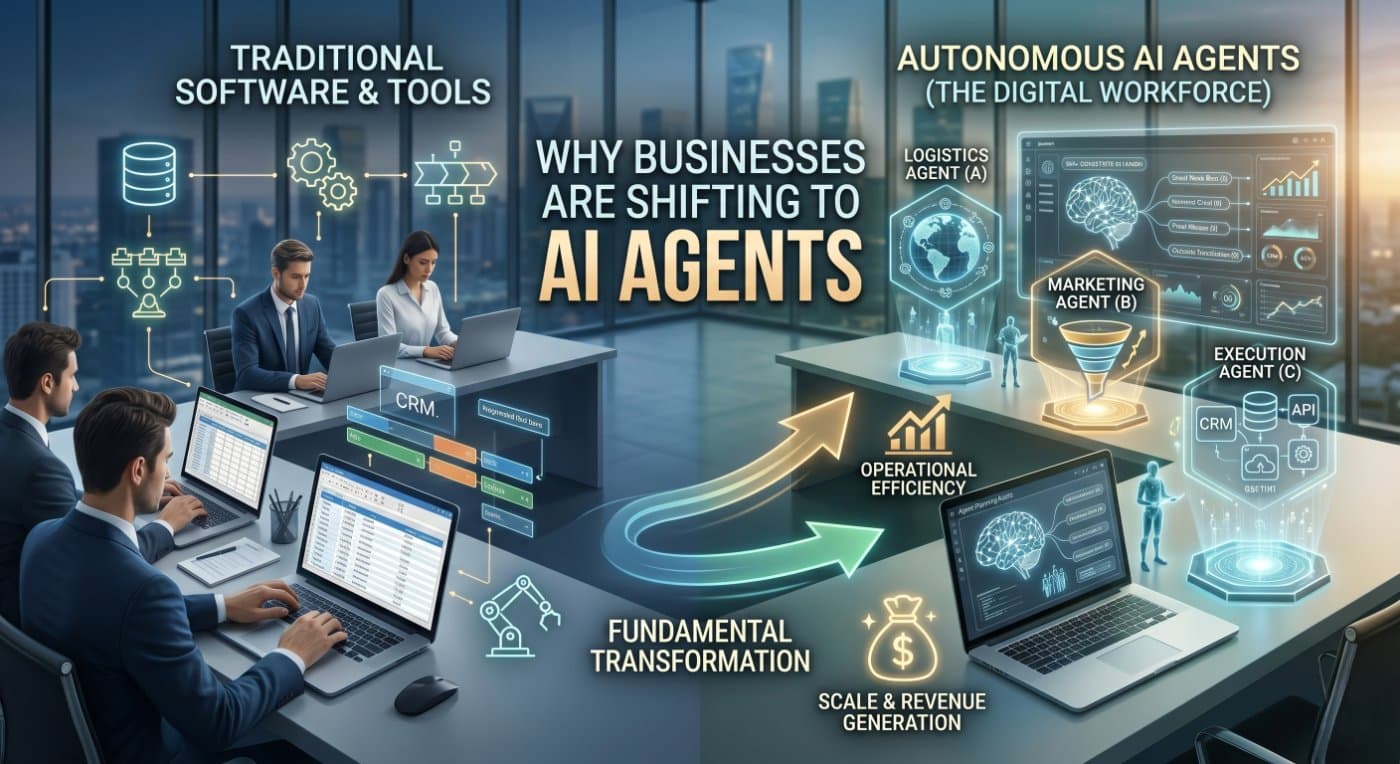
Why sales, and why first
Every department has repetitive work. Sales got automated first because it has five properties at once: the work is repetitive, it is script-based, it runs on data, it is workflow-heavy, and it scales. Most of what a sales team does is not creative judgement — it is executing a known sequence. Lead, contact, follow up, qualify, book, close.
Then there is the commercial reason, which is the real one. Sales sits directly on revenue and is trivially easy to measure. A business can tell within a fortnight whether an agent answering enquiries made money, which is not true of an agent tidying the file server. Companies automate the thing they can measure and that pays, and they do it before the things they cannot.
The unglamorous mechanism underneath all of it: response time. A lead answered in thirty seconds and the same lead answered the next morning are not the same lead. Most businesses lose more revenue to the gap between enquiry and reply than to anything their sales training addresses, and closing that gap needs no persuasion skill at all — only presence.
What an AI sales agent actually does
An AI sales agent is a system that runs the sales process end to end rather than assisting with pieces of it. In practice it connects to the tools the business already has — a CRM like HubSpot or Salesforce, the email platform, the outreach tooling, the calendar — and then repeats a loop:
- Find. Identify businesses or people matching the target criteria: industry, size, location, behaviour, interest signals.
- Research. Read each prospect properly — company size, likely pain points, who actually decides, what they have been doing publicly.
- Write. Produce a message specific to that prospect rather than a template with a name dropped in. Email, LinkedIn, SMS, WhatsApp, whatever channel they use.
- Follow up. Send the reminders nobody remembers to send, adjusting tone to the reply, keeping the thread alive without nagging.
- Handle the conversation. Answer the questions and the routine objections, provide the product detail, recommend the right option.
- Qualify. Score against interest, budget and buying intent, so only serious prospects reach a human.
- Book. Put the call straight into the calendar, no back-and-forth.
- Record. Update the CRM as it goes, which is the step human teams skip most and which makes every report downstream wrong.
That loop — goal, plan, act with a tool, check the result, go again — is the ordinary agent loop described in what an AI agent is. Sales is simply the place where it maps most cleanly onto an existing job description.
The funnel, automated stage by stage
Zoom out from the agent to the funnel and the same principle applies at each stage: awareness, interest, decision, conversion. The traditional version needs a person pushing leads from one stage to the next, with separate tools at each step and things falling between them.
Traffic. Content and ads, tested and adjusted continuously rather than set and reviewed quarterly. Capture. Landing pages, forms, chat and messenger, so an interested person cannot arrive and find nowhere to leave their details. Qualification. Not every lead is worth the same, and behaviour signals, engagement history and stated intent sort them without anyone reading each one. Nurture. This is where automated funnels earn their keep: personalised follow-up by email, WhatsApp or retargeting, pitched at where that person actually is rather than which day of the sequence they are on. Conversion. Objections answered, options recommended, the call booked — and for low-ticket products, frequently completed without a human at all. After the sale. Onboarding messages, feedback requests, the upsell at the sensible moment, and support, which is the part most funnels forget is part of the funnel.
The important change is not that each stage is faster. It is that no lead sits in a gap between stages waiting for somebody to notice it.
The marketing layer above it
Marketing automates on the same pattern one level up, and this is where multi-agent structures genuinely make sense, because the jobs are different jobs. A strategy layer holds the goal — awareness, leads, conversions. A content layer produces the posts, articles, ad copy and scripts. A distribution layer publishes to each platform on its own rhythm. An optimisation layer runs the paid side: testing creatives, adjusting targeting, moving budget toward whatever is working. An analytics layer watches click-through, engagement and conversion, and feeds what it learns back to the others.
Put that together with the funnel below it and you get something close to a self-running revenue system: content generates traffic, traffic becomes leads, leads get nurtured and qualified, calls get booked, and a human closes the ones worth a human. Agencies and e-commerce brands were first to build this properly because they run the same campaign shape repeatedly across clients or product lines.
The limits are real and mostly about voice. An agent producing a month of content in your brand's voice requires that voice to be written down somewhere precise; "be professional but friendly" is not a specification a machine can follow. The 7-Part Job Description exists for exactly this reason.
Support is the other half of the same system
Support and sales are usually run as separate departments and are, mechanically, the same problem: a queue of messages, mostly repetitive, where speed is the main determinant of satisfaction.
Modern support agents are not the scripted chatbots that made everyone hate chatbots. The difference is categorical: a chatbot follows fixed rules down a decision tree, has no memory, and cannot do anything except reply. An agent understands context and sentiment, holds a multi-step conversation, reads the company's own data, and takes actions — tracking an order, processing a refund, updating an account, making a booking, raising a ticket.
The workflow is plain. The message arrives, by web chat, email, WhatsApp or social. The agent reads intent, urgency and mood. It pulls the answer from the FAQ, the product documentation, the database or the CRM. It acts where action is what is needed. And when the case is genuinely complex or the customer is genuinely upset, it hands over to a human with the entire conversation attached — which is the detail that decides whether customers experience the handover as help or as being passed around.
E-commerce uses this for order tracking, refunds, returns and product questions. Software companies use it for technical support, subscriptions and account problems. Service businesses use it for bookings, availability and pricing. In each case first-level support is handled and the humans get the cases that need a person.
Why businesses switch, and the honest comparison
The advantages are structural rather than clever. It answers at midnight and across timezones. It answers instantly. It costs the same whether the volume is a hundred messages or a hundred thousand. It gives every customer the same accurate answer, where a human team's quality varies with the hour and the person. And it does not skip the CRM update.
Set against a human team fairly: a salesperson works limited hours, holds a limited number of relationships in their head, needs training and ramp-up, follows up inconsistently under load, and costs salary plus commission. An agent works continuously, handles arbitrary volume, executes the same process every time, and costs a subscription. On execution it wins on every axis, which is why this is happening.
What a salesperson has that an agent does not: the ability to build trust with someone spending serious money, read a room, recognise the objection behind the stated objection, and be accountable in a way a customer can feel. Those are not small things, and they are concentrated almost entirely at the top of the deal-size range.
The model that actually wins is hybrid
The companies getting real results are not replacing their sales teams. They are re-cutting the work: agents take outreach, follow-up, qualification and CRM hygiene; humans take relationships, negotiation, and closing the deals where the value justifies the attention.
So the shape of a sales department changes rather than shrinking to nothing. One strategist who decides who is being targeted and what is being said. Several agents handling volume. Human closers on the high-value pipeline. The leverage sits with whoever designs the system rather than whoever makes the most calls, and that is a genuinely different skill from the one sales careers have rewarded until now.
It is also why this list of jobs is worth reading as a set rather than one at a time — the same pattern is arriving in eight other functions, as ten ways businesses are using agentic AI sets out.
What the customer actually gets
Most writing on this is framed entirely around what the business saves, which misses why it works. From the customer's side the improvements are the ones they have always wanted: an answer immediately instead of a queue, at whatever hour they happened to have the question, from something that already knows their order history, and a resolution in one exchange rather than three.
The trajectory is toward support that is proactive rather than reactive — the delivery delay flagged before the customer chases it, the failing subscription payment raised before it lapses. That is a genuinely better experience, not a cheaper version of the old one, and it is only possible when something is watching continuously.
Where it becomes worse is well understood too: the frustrated customer trapped in an automated loop with no route to a person. Every system that works has an escape hatch, and the businesses that hide it to save money lose more than they save.
The economics, roughly
The arithmetic is why this is moving so fast, and it is simple enough to do on the back of an envelope. A sales or support hire costs a salary every month, plus commission, plus the ramp-up before they are productive, plus the cost of doing it again when they leave. An agent costs a model subscription and whatever the surrounding tooling runs to — tens of dollars a month for most small businesses, not thousands.
The number that matters is not the saving, though. It is the ratio between the cost of the agent and the value of a single recovered lead. If one enquiry a month that would previously have gone unanswered until morning turns into a customer, the whole thing has paid for itself several times over. That is the calculation to run before building anything, using your own average order value rather than anybody's case study.
What the arithmetic does not cover is the cost of doing it badly: the burned contact list, the customer who left because nobody answered the complaint properly. Those are real and they do not show up in a spreadsheet, which is the case for supervision rather than against automation.
Where it breaks
Five failure modes, all of them common:
- Bad data in. An agent working from a stale list or an out-of-date price sheet produces confident, fluent, wrong output at scale. Speed multiplies the error rather than the value.
- Personalisation that is not personal. High volume with shallow research reads exactly like what it is, and it burns the list permanently. One well-researched message beats a hundred mail-merged ones.
- Complex objections. An agent handles the routine objection well and misreads the subtle one — the prospect who says price and means risk. That conversation belongs to a person.
- Brand voice drift. Left unsupervised across thousands of messages, tone wanders. This needs sampling the output weekly, not trusting the setup.
- Compliance. Messaging rules, privacy law and platform policy all apply to an agent exactly as they apply to a person, and "the system sent it" is not a defence.
Every one of those is an argument for supervision, not for waiting. Start with one narrow job, watch the output, and widen only when it has been dull for a fortnight.
What to do about it
If you run a business, the first agent to build is the one answering your inbound enquiries, because the cost of the status quo is already measurable and the build is small. DSP's own AI Employees are exactly this: a sales, support or booking agent for one business, on the channel its customers already use.
If you are in sales and reading this with some alarm, the useful response is not to get better at the part being automated. It is to become the person who designs and supervises the system — which is a skill you can acquire without a technical background, and which is what DSP AI Agent Mastery is for.
Ready to build AI agents yourself?
DSP AI Agent Mastery — self-paced, 16 modules, starts from zero.
Start AI Agent Mastery →