
AI Training
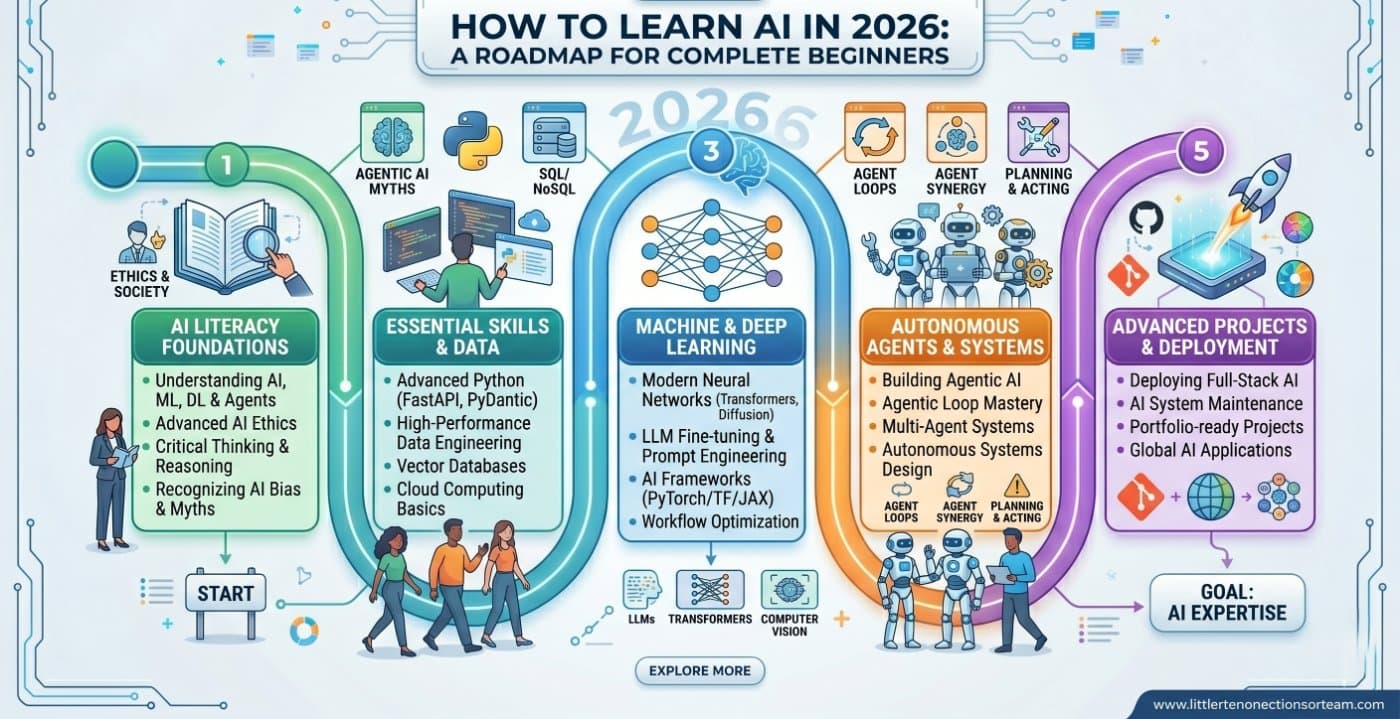
How to Learn AI in 2026: A Roadmap for Complete Beginners
Short answer
Learn AI in 2026 by building, not by collecting tutorials: understand what an AI agent is, learn to write clear instructions for Claude, build one small agent with Claude Code, give it memory and tools, deploy it to a live URL, and put it in front of one real user. No Python is required for that path, and the tools cost about $20 a month from the third stage on.
The problem is not a shortage of material
There is more free AI content than any person could work through in a decade. Tutorials, courses, videos, newsletters, papers, podcasts. The difficulty is not access — it is that none of it tells you what order to do things in, so most people bounce between beginner explainers for six months and end up able to discuss AI without being able to do anything with it.
What follows is a sequence with a stated reason for each step, starting from nothing. The weeks are indications rather than promises: some phases overlap deliberately, and the only part that is genuinely non-negotiable is the last line of this page.
What you are actually learning
The goal is AI literacy, and it is worth being precise about what that means, because the word gets used to sell both too much and too little. It does not mean building neural networks or studying the mathematics. It means understanding what these systems can and cannot do, working with the tools effectively, judging their output critically rather than accepting it, and holding enough of a conceptual model to take part in decisions about where AI should and should not be used.
Financial literacy is the right analogy. You do not need to be a banker, but you do need to understand money well enough to make decisions that are not stupid. Same shape here.
The gap this opens is not subtle. In organisations that have adopted these tools, the difference between people who use them daily and people who have merely read about them is large and visible in the work — not only in speed, but in what they attempt. The AI-literate ones take on more ambitious work, produce more options, and become harder to replace. That gap is the whole reason to do this deliberately rather than casually.
It is also learnable by anyone, which is not true of every technological shift. The barrier is not mathematical talent or a programming background. It is curiosity, some scepticism, and a willingness to keep opening the tools.
Phase 1 · Build the mental model (weeks 1–2)
Before tools, get a working picture of what the thing is. You want to be able to explain machine learning, neural networks, training data, language models and agents to somebody else without reaching for jargon. That explanation is the test — if you cannot give it, the later phases will not stick, because you will be pattern-matching instead of reasoning.
Stuart Russell's Human Compatible and Brian Christian's The Alignment Problem are both accessible and both serious. Our own AI, machine learning and deep learning explainer covers the nesting and what a language model actually does, and what an AI agent is covers the loop that makes an agent different from a chatbot. Two weeks is plenty.
Do not spend longer here. The failure mode at this stage is enjoying the reading too much.
Phase 2 · Become a power user (weeks 3–6)
Now use the tools for real work, every day. ChatGPT, Claude, Gemini, Perplexity — whichever you have access to, and more than one if you can, because their differences teach you something. The instruction that matters: use them on actual tasks, not on experiments. Real emails, real documents to summarise, real decisions to think through, real data to analyse. Generate some code even if you are not a developer and have no intention of becoming one.
What you are building is intuition — where these models are strong, where they quietly fail, how differently they respond to a well-framed request. That intuition cannot be read, only accumulated. It arrives much faster with daily use than with weekly use, in the way that living in a country beats studying its language.
By the end of this phase you should have caught a model being confidently wrong at least twice. If you have not, you are not checking.
Phase 3 · Learn to write instructions (weeks 5–8)
Overlapping with phase 2 on purpose. Writing instructions that reliably produce good output is the highest-leverage skill in this entire list, and the one most people skip because it sounds too simple to matter.
The core techniques are few: give the model a role, show it an example of what good looks like, ask for the output in a stated format, and let it reason step by step on anything with more than one stage. Then practise deliberately — same task, three framings, compare. The difference between a mediocre result and an excellent one is almost never the model. It is the person writing the request, which is the argument in how to write effective AI prompts.
This phase pays for itself immediately and keeps paying, because an agent is nothing more than a standing instruction that runs repeatedly. Get sloppy here and everything downstream inherits the sloppiness.
Phase 4 · Build something that runs without you (weeks 8–12)
This is the step that separates people who have learned AI from people who have been reading about it, and it is where most roadmaps stop being honest about the work involved.
Start with no-code automation — Zapier or Make will get you a working AI-powered workflow without writing anything. Then move to something with more room in it: n8n, Relevance AI, or building directly against a model's API with an assistant writing the code alongside you. The goal is deliberately unglamorous: one thing that runs on its own and delivers something you would notice if it stopped. An agent that watches a page and summarises what changed each morning is a perfectly good first build.
Then deploy it to a URL that is not your laptop, and put it in front of one real person who is not you. Everything important that you have not yet learned shows up in that last step — the edge cases, the costs, the difference between works-on-my-machine and works. This is also the point where a roadmap becomes a portfolio: one deployed thing is worth more in a conversation with an employer or client than any certificate.
Phase 5 · Specialise in your own field (ongoing)
AI looks different in every profession, and generic competence stops being interesting quite quickly. A doctor's version of this is clinical decision support and patient privacy. A marketer's is content production and attribution. A lawyer's is document review and research. An accountant's is reconciliation and anomaly detection.
Once the foundations are in, go deep on the tools and applications specific to what you already know. This is the part that makes you difficult to replace, because it combines domain knowledge somebody else does not have with a capability most of your colleagues do not have. The people getting the most out of this are rarely the most technical ones in the room — they are the ones who understood the business problem first.
What the market is actually paying for
Worth being clear-eyed about this, because it determines what is worth your time. Employers and clients are not, in the main, paying for the ability to build models. Very few businesses need that. They are paying for people who can make AI do useful work on a real problem faster than their competition manages it.
Concretely: writing instructions that work, building automation that runs unattended, producing content and analysis at volume without it turning to mush, and knowing which tool suits which job. The hiring pattern that follows is visible across content, marketing, support, lead generation and data work — smaller teams of people who are each producing considerably more, rather than the same team going slightly faster.
The reason the premium exists is supply, not magic: the number of businesses that want an agent answering their customers is much larger than the number of people who can build and deploy one. Since 2026 that no longer requires a computer science degree or Python, which is precisely why the gap is open to career changers — and why it will narrow. How to learn AI agents in Pakistan maps this same route onto local costs, tools and clients.
What a structured program can and cannot do
You can do everything above on your own, and some people do. A program's honest value is order and accountability: the sequence is decided for you, the gaps are covered whether or not you knew they existed, and somebody answers when you are stuck at 1am on an error message that means nothing to you.
What to expect from a good one: both halves, conceptual and practical. How these systems work at a level that lets you reason about them, the types of AI and how they differ, the agent loop, and the ethics of handing autonomy to software. Then the practical side — the tools, the prompting, building workflows, and judging output critically. A fixed order of topics, one project that grows through all of them, and support that outlasts the classes. Ours is set out module by module in the Mastery curriculum, and nine of the options available locally are compared in best AI courses in Pakistan.
What it requires from you is the part the marketing tends to omit. Learning this is not passive. Expect to practise between sessions, to be confused regularly — that confusion is the learning — and to keep going after the course ends, because the field does not hold still. Bring a real problem from your own work and use the training to solve it. The programs that produce results are the ones whose students turn up with something they actually want to build.
And be suspicious of any program whose main promise is a certificate. A certificate is the weakest thing a course can give you. The test is whether you finish with something running that you built — the case made in hands-on versus theory-only training.
The rule that decides whether any of this works
Use it every day, starting in week one, while you are still learning the concepts.
That is the whole secret and it is unsatisfying. The distance between somebody who reads about AI and somebody who uses it daily is enormous, and it compounds weekly. Theory without practice stalls in about a fortnight. If you take nothing else from this roadmap, open one of these tools tomorrow for something you were going to do anyway — and then keep the phases in mind as a route rather than a schedule. DSP AI Agent Mastery runs that route end to end if you would rather not assemble it yourself.
Ready to build AI agents yourself?
DSP AI Agent Mastery — self-paced, 16 modules, starts from zero.
Start AI Agent Mastery →