
AI for Business
Small Teams Scaling Like Large Companies with AI Agents
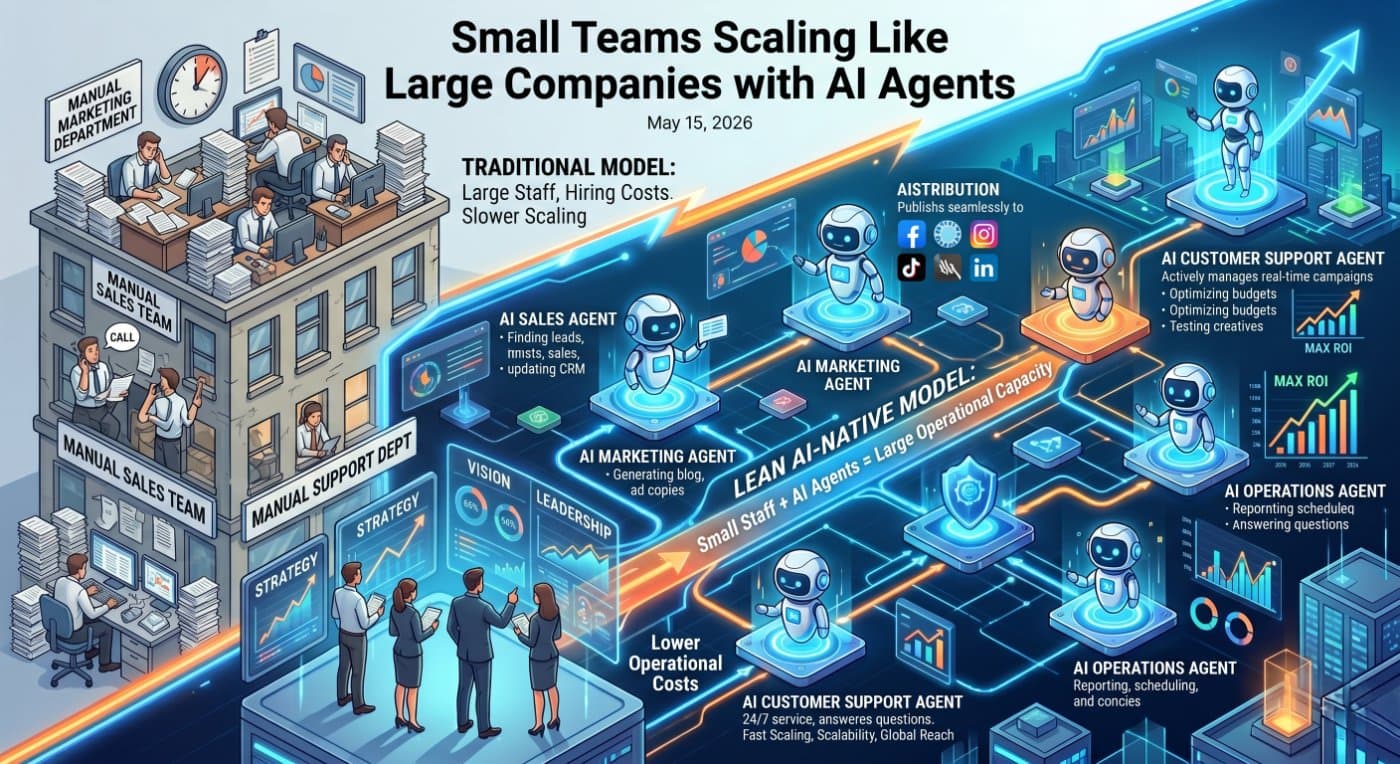
Small Teams Scaling Like Large Companies with AI Agents
For decades, business growth followed a predictable formula:
More customers meant hiring more employees.
More operations meant building larger departments.
More growth meant more complexity.
But Artificial Intelligence is changing this model completely.
Today, small teams can operate at the scale of much larger companies by using AI agents, automation systems, and autonomous workflows.
This is one of the biggest shifts happening in modern business.
The Traditional Business Scaling Problem
In traditional companies, scaling usually creates major challenges:
- Hiring costs increase
- Management becomes more difficult
- Operations slow down
- Communication complexity grows
- Customer support becomes expensive
- Marketing requires larger teams
As businesses grow, operational pressure increases rapidly.
This is why scaling has historically been difficult for startups and small companies.
How AI Is Changing the Scaling Model
AI agents now allow businesses to automate large portions of operations that previously required human teams.
Instead of hiring more employees for every stage of growth, companies can deploy AI systems that:
- Execute workflows
- Handle communication
- Process information
- Manage repetitive tasks
- Operate continuously
This creates a new business model where:
Small human teams + AI agents = Large operational capacity
What Are AI Agents?
AI agents are intelligent systems capable of:
- Completing tasks autonomously
- Making decisions
- Using digital tools
- Managing workflows
- Learning from data
- Executing multi-step operations
Unlike traditional software, AI agents do not simply wait for instructions.
They can actively work toward business goals.
Areas Where Small Teams Use AI to Scale
1. AI Marketing Systems
A small marketing team can use AI agents to:
- Generate content
- Run ad campaigns
- Publish social media posts
- Analyze campaign performance
- Optimize targeting
One or two people can manage marketing operations that previously required an entire department.
2. AI Sales Automation
AI sales agents can:
- Find leads
- Send outreach
- Handle follow-ups
- Qualify prospects
- Update CRM systems
This allows small teams to operate large-scale sales systems with minimal manpower.
3. AI Customer Support
AI support agents can:
- Answer customer questions
- Handle tickets
- Provide 24/7 service
- Process common requests
Businesses can support thousands of customers without building massive support teams.
4. AI Operations Management
AI systems can automate:
- Reporting
- Scheduling
- Data processing
- Workflow management
- Administrative tasks
This reduces operational bottlenecks as companies grow.
Why Small Teams Are Becoming More Powerful
Lower Operational Costs
AI reduces dependence on large employee structures.
Businesses save on:
- Salaries
- Training
- Office infrastructure
- Administrative management
Faster Execution
AI systems work instantly and continuously.
This allows small companies to move faster than traditional organizations.
Scalability Without Massive Hiring
Previously, growth required proportional increases in staff.
Now businesses can scale operations using:
- AI workflows
- Autonomous systems
- Multi-agent AI structures
without dramatically increasing team size.
Global Reach
AI systems allow small teams to:
- Operate internationally
- Serve customers globally
- Run 24/7 businesses
- Manage multiple markets simultaneously
The Rise of Lean AI-Native Companies
A new generation of businesses is emerging where:
- Human teams stay intentionally small
- AI systems handle operational execution
- Automation drives scalability
These businesses are often called:
AI-native companies
Their competitive advantage comes from:
- Speed
- Efficiency
- Automation
- Intelligent workflows
rather than company size alone.
Human Roles Are Changing
Small teams still play a critical role.
Humans increasingly focus on:
- Strategy
- Creativity
- Leadership
- Vision
- Relationship building
- AI system oversight
AI handles repetitive execution while humans guide direction.
Challenges Small Teams Must Manage
Despite the advantages, businesses still face important challenges:
Quality Control
AI systems require monitoring to maintain quality.
Security & Privacy
Handling customer data responsibly remains essential.
Overdependence on Automation
Businesses must avoid losing human connection and brand authenticity.
Continuous Adaptation
AI technology evolves rapidly, requiring ongoing learning and optimization.
The Future of Business Scaling
The future may belong to businesses that:
- Stay lean
- Operate intelligently
- Use AI systems effectively
- Focus on automation and execution
In the coming years, we may see:
- Small startups competing with large enterprises
- Solo founders operating global companies
- AI-driven operational structures replacing traditional departments
The relationship between company size and business power is changing forever.
Ready to build AI agents yourself?
DSP AI Agent Mastery — self-paced, 16 modules, starts from zero.
Start AI Agent Mastery →