
AI for Business
The Rise of AI-Native Companies: How Artificial Intelligence Is Redefining Modern Business
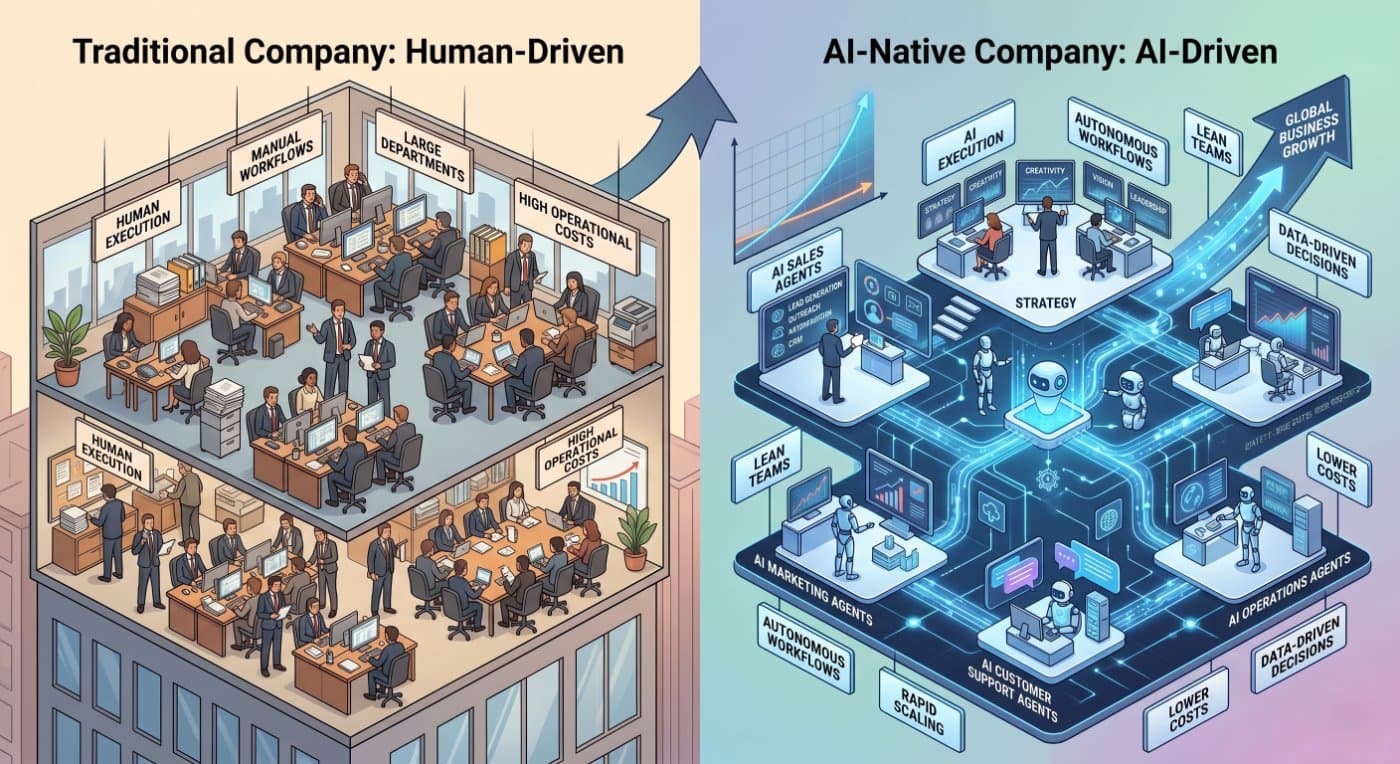
The Rise of AI-Native Companies: How Artificial Intelligence Is Redefining Modern Business
A major transformation is happening in the global business world.
For decades, companies were built around human teams using software tools to improve productivity. Businesses hired employees, created departments, and used technology mainly as support systems.
But now a completely new type of company is emerging:
AI-Native Companies
These businesses are designed from the ground up around Artificial Intelligence systems, AI agents, and autonomous workflows.
Instead of simply “using AI,” these companies are fundamentally built to operate with AI at their core.
This shift is changing entrepreneurship, operations, marketing, sales, customer service, and even the definition of a company itself.
What Is an AI-Native Company?
An AI-native company is a business where AI systems are deeply integrated into the company’s operations, decision-making, and execution processes.
In traditional companies:
- Humans perform most operational work
- Software acts as a tool
In AI-native companies:
- AI systems perform large portions of execution
- Humans focus on strategy, creativity, and leadership
AI becomes part of the workforce itself.
Traditional Companies vs AI-Native Companies
Traditional CompaniesAI-Native CompaniesHuman-heavy operationsAI-driven operationsLarge departmentsLean human teamsManual workflowsAutonomous workflowsSlower scalingRapid scalingHigh operational costsLower operational overheadHuman executionAI execution
Why AI-Native Companies Are Emerging
Several technological breakthroughs made this possible:
1. Large Language Models (LLMs)
Modern AI systems can now:
- Understand language
- Reason through problems
- Generate human-like communication
- Analyze information
2. AI Agents
AI agents can:
- Execute tasks
- Use software tools
- Manage workflows
- Make decisions
- Operate autonomously
3. Workflow Automation
AI systems can now connect with:
- CRMs
- Email platforms
- Analytics dashboards
- Payment systems
- Marketing tools
This allows AI to manage real operational processes.
How AI-Native Companies Operate
AI-native businesses often use networks of AI agents for different functions.
AI Sales Agents
Handle:
- Lead generation
- Outreach
- Follow-ups
- CRM management
AI Marketing Agents
Manage:
- Content creation
- Advertising
- Social media
- Campaign optimization
AI Customer Support Agents
Provide:
- 24/7 support
- Ticket resolution
- Customer onboarding
- Automated responses
AI Operations Agents
Handle:
- Reporting
- Scheduling
- Data processing
- Workflow management
Small Teams, Massive Scale
One of the most powerful aspects of AI-native companies is scalability.
A small team can now operate like a much larger organization using AI systems.
For example:
- A solo entrepreneur can run global marketing campaigns
- Small startups can automate customer support
- Lean businesses can manage thousands of leads simultaneously
AI dramatically increases operational leverage.
Why Investors and Businesses Are Paying Attention
AI-native companies offer several major advantages:
Lower Costs
Fewer repetitive human tasks reduce operational expenses.
Faster Execution
AI systems operate instantly and continuously.
Better Scalability
Businesses can grow rapidly without proportional hiring increases.
Continuous Operations
AI systems function 24/7 across global markets.
Data-Driven Optimization
AI continuously analyzes and improves performance.
The Shift from Employees to AI Systems
Historically, business growth meant:
- Hiring more people
- Expanding departments
- Increasing operational complexity
AI-native companies challenge this model.
Now growth increasingly comes from:
- Better AI systems
- Smarter workflows
- Autonomous operations
This changes the economics of business itself.
Human Roles in AI-Native Companies
Humans remain essential — but their roles evolve.
People increasingly focus on:
- Vision
- Leadership
- Strategy
- Creativity
- Relationship building
- Ethical oversight
Meanwhile, AI handles much of the operational execution.
Challenges Facing AI-Native Companies
Despite their advantages, these businesses also face challenges:
AI Reliability
AI systems can still make mistakes.
Data Privacy & Security
Handling customer data responsibly is critical.
Ethical Concerns
Businesses must ensure responsible AI behavior.
Regulatory Compliance
AI regulations are rapidly evolving worldwide.
Human Oversight
AI systems still require supervision and governance.
The Future of AI-Native Businesses
Many experts believe AI-native companies will become one of the dominant business models of the future.
In the coming years, we may see:
- AI-first startups
- Fully autonomous online businesses
- AI-managed operations
- Multi-agent AI organizations
Businesses that adopt AI early may gain significant competitive advantages in:
- Speed
- Efficiency
- Innovation
- Market expansion
Ready to build AI agents yourself?
DSP AI Agent Mastery — self-paced, 16 modules, starts from zero.
Start AI Agent Mastery →