
AI for Business
Automated Operations: How AI Is Rebuilding the Way Businesses Run
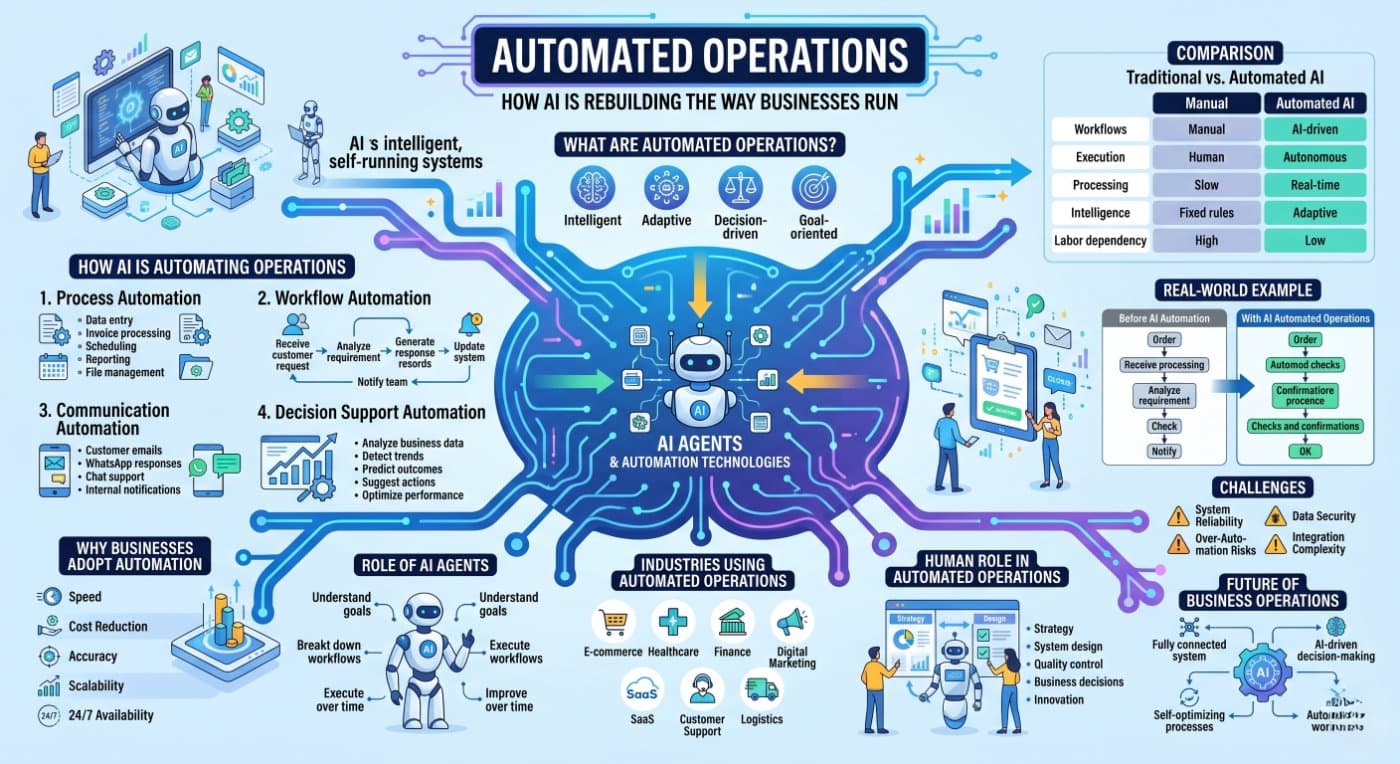
Automated Operations: How AI Is Rebuilding the Way Businesses Run
Business operations are the backbone of every company the invisible engine that keeps everything moving.
Traditionally, operations have been heavily dependent on human effort, manual coordination, and time-consuming processes.
But today, a major transformation is happening:
Automated Operations Powered by AI
Businesses are moving from manual workflows to intelligent, self-running systems powered by AI agents and automation technologies.
This shift is redefining efficiency, speed, and scalability in modern organizations.
What Are Automated Operations?
Automated operations refer to business processes that are executed with minimal human intervention using technology, software, and AI systems.
In the past, automation meant simple rule-based systems.
Now, with AI, automation has become:
- Intelligent
- Adaptive
- Decision-driven
- Goal-oriented
This is the foundation of Agentic AI systems.
Traditional Operations vs Automated AI Operations
Traditional Operations Automated AI Operations Manual work flows AI-driven workflows Human execution required Autonomous execution Slow processing Real-time execution Fixed rules Adaptive intelligence High labor dependency Low human dependency
How AI Is Automating Business Operations
Modern AI systems can now handle entire operational layers inside a business.
1. Process Automation
AI systems can manage repetitive tasks such as:
- Data entry
- Invoice processing
- Scheduling
- Reporting
- File management
This reduces operational workload significantly.
2. Workflow Automation
AI agents can connect multiple systems and execute full workflows:
Example:
- Receive customer request
- Analyze requirement
- Generate response
- Update system records
- Notify team
All automatically.
3. Communication Automation
AI can handle:
- Customer emails
- WhatsApp responses
- Chat support
- Internal notifications
This ensures instant communication across the business.
4. Decision Support Automation
Advanced AI systems can:
- Analyze business data
- Detect trends
- Predict outcomes
- Suggest actions
- Optimize performance
Some systems even execute decisions automatically based on rules and goals.
Real-World Example of Automated Operations
Before AI Automation:
A business processes an order like this:
- Staff receives order
- Manually checks inventory
- Updates system
- Sends confirmation email
- Notifies shipping team
- Tracks status manually
With AI Automated Operations:
- Order is received
- AI checks inventory instantly
- System is updated automatically
- Customer gets confirmation
- Shipping is scheduled
- Tracking updates are sent automatically
Entire workflow runs without human involvement.
Why Businesses Are Adopting Automated Operations
1. Speed
AI systems operate instantly without delays.
2. Cost Reduction
Businesses reduce dependency on large operational teams.
3. Accuracy
Automation reduces human errors in repetitive tasks.
4. Scalability
Systems can handle thousands of operations simultaneously.
5. 24/7 Availability
AI systems never stop working, allowing continuous operations.
The Role of AI Agents in Automation
AI agents are the next step in automation evolution.
They do not just follow rules — they:
- Understand goals
- Break tasks into steps
- Execute workflows
- Adapt based on results
- Improve over time
This makes operations more intelligent and dynamic.
Industries Using Automated Operations
Automated systems are transforming industries such as:
- E-commerce
- Healthcare
- Finance
- Digital marketing
- SaaS companies
- Customer support services
- Logistics and supply chain
Any business with repetitive workflows can benefit from automation.
Human Role in Automated Operations
Even in highly automated systems, humans remain important.
Humans focus on:
- Strategy
- System design
- Quality control
- Business decisions
- Innovation
AI handles execution, while humans guide direction.
Challenges of Automated Operations
Despite the benefits, businesses must manage:
System Reliability
AI systems must be monitored for errors.
Data Security
Sensitive information must be protected.
Over-Automation Risks
Too much automation can reduce human touch in customer experience.
Integration Complexity
Connecting multiple systems requires proper setup.
The Future of Business Operations
The future of operations will be:
- Fully connected systems
- AI-driven decision-making
- Autonomous workflows
- Self-optimizing processes
Businesses will increasingly operate like intelligent ecosystems rather than manual organizations.
Ready to build AI agents yourself?
DSP AI Agent Mastery — self-paced, 16 modules, starts from zero.
Start AI Agent Mastery →