
AI Ethics
AI Bias Explained: What It Is, Where It Comes From, and How to Reduce It
AI Bias Explained: What It Is, Where It Comes From, and How to Reduce It
One of the most consequential and frequently misunderstood aspects of AI is bias. When people hear that AI systems are biased, some dismiss it as a political talking point. Others panic and conclude AI is fundamentally untrustworthy. The reality is more nuanced and understanding it is essential for anyone who wants to use AI responsibly or deploy it in consequential applications.
What Is AI Bias?
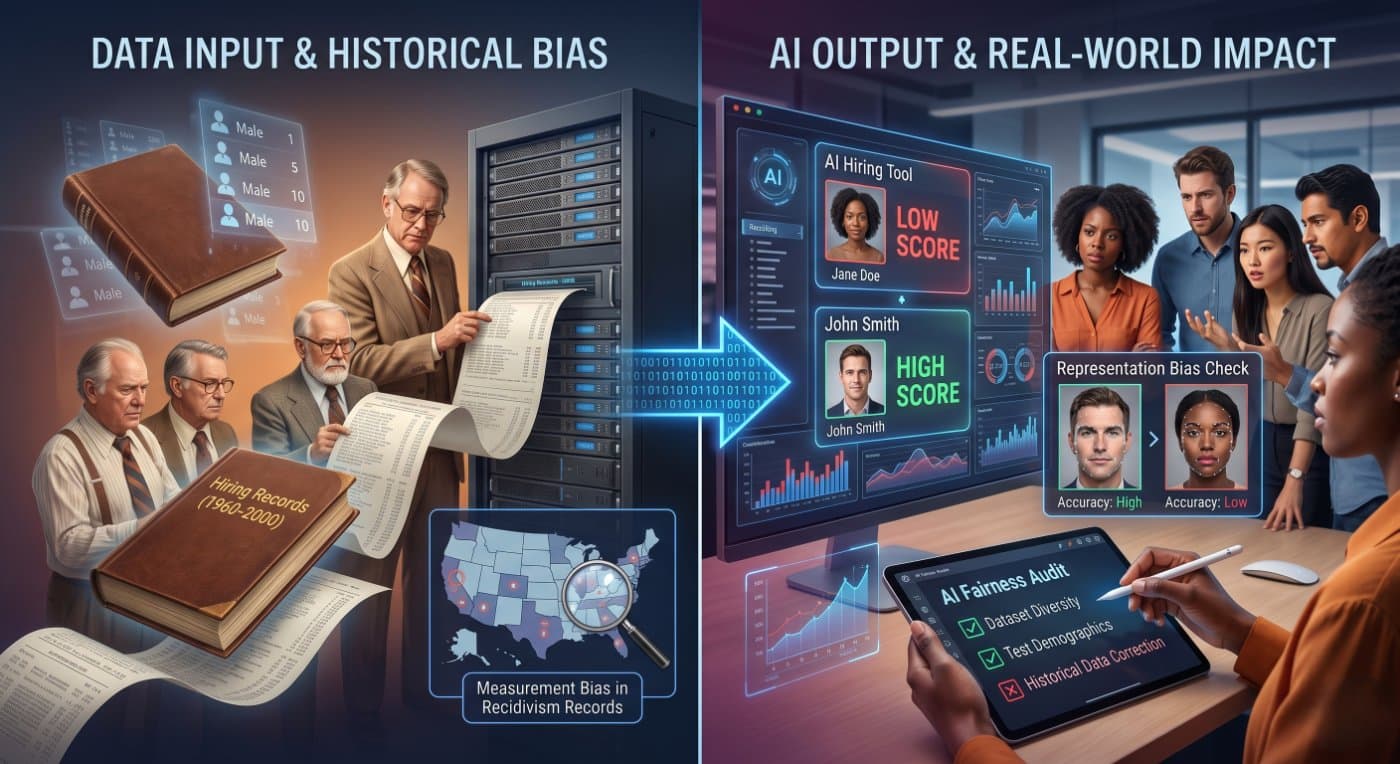
AI bias is the systematic tendency of an AI system to produce outputs that are consistently skewed in a particular direction usually in ways that disadvantage certain groups. This is not about AI having opinions or prejudices. It is about mathematics: AI systems learn from training data, and if that data reflects historical inequalities, the model will learn and reproduce those inequalities, often amplifying them.
Where Bias Comes From
Training Data Bias: If you train a hiring AI on decades of hiring records from an industry that historically favored men, the AI learns that "being male" correlates with "getting hired" and will discriminate against women, even if gender is not explicitly included as a feature. Amazon famously scrapped an AI recruiting tool for exactly this reason. Representation Bias Facial recognition systems trained primarily on light-skinned faces perform significantly worse on dark-skinned faces. Medical AI trained on data from wealthy countries may perform poorly in low-income settings with different disease patterns and limited diagnostic infrastructure. Measurement Bias The way we measure a concept can introduce bias. "Criminal recidivism" used to determine parole decisions has embedded racial bias because policing and prosecution practices themselves have been racially unequal.
How to Reduce Bias
Eliminating bias entirely is likely impossible but reducing it significantly is achievable with intentional effort: auditing training datasets for representation gaps; testing AI systems across different demographic groups before deployment; including diverse perspectives in design teams; using bias detection tools throughout the development process; and establishing ongoing monitoring after deployment to catch drift or newly emerging bias patterns.
"AI does not create bias it reflects and amplifies the biases already present in data, in institutions, and in the societies that produced them. Addressing AI bias means addressing these deeper realities.
Ready to build AI agents yourself?
DSP AI Agent Mastery — self-paced, 16 modules, starts from zero.
Start AI Agent Mastery →