
Agentic AI
AI Assistants vs AI Agents: Understanding the Future of Artificial Intelligence
Short answer
An AI assistant is reactive — ChatGPT, Siri, a support chatbot — it waits for your instruction and answers it. An AI agent is proactive: given a goal it plans, decides, uses software tools and executes a multi-step workflow to completion. The practical test is whether the system finishes the job or hands the work back to you.
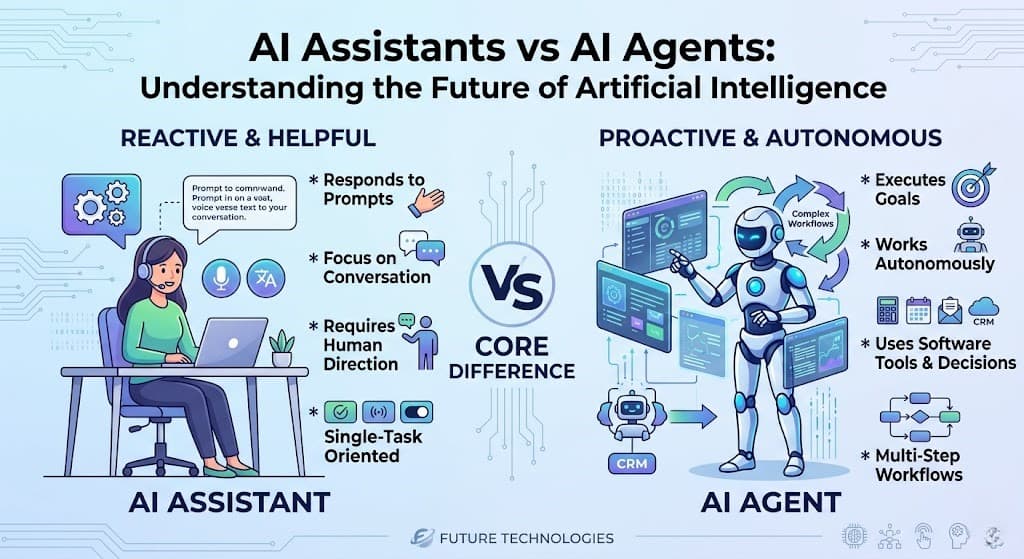
AI Assistants vs AI Agents: Understanding the Future of Artificial Intelligence
Artificial Intelligence is evolving faster than ever.
For years, businesses used AI mainly as a chatbot or virtual assistant to answer questions, generate content, or provide support.
But now a new era has arrived:
The Era of AI Agents
AI is no longer limited to simply responding to prompts.
Modern AI systems can now think through tasks, make decisions, use tools, execute workflows, and complete real business operations autonomously.
This is the major difference between AI Assistants and AI Agents.
What Is an AI Assistant?
An AI Assistant is a system designed to help users by responding to commands or questions.
Popular examples include:
- ChatGPT
- Siri
- Alexa
- Google Assistant
- Customer support chatbots
These systems are reactive.
They wait for human instructions and then generate responses based on the request.
Common Features of AI Assistants
- Answering questions
- Writing content
- Summarizing information
- Translating languages
- Providing recommendations
- Assisting with customer support
AI assistants are excellent at communication and productivity enhancement.
However, they usually require continuous human guidance.
What Is an AI Agent?
An AI Agent goes much further.
Instead of only answering questions, an AI agent can:
- Plan tasks
- Make decisions
- Use software tools
- Analyze information
- Execute actions
- Work toward goals autonomously
AI agents are proactive systems.
They can independently perform multi-step workflows with minimal human involvement.
Simple Example
AI Assistant:
“Write an email to a customer.”
The assistant generates the email.
AI Agent:
- Finds new leads
- Researches prospects
- Writes personalized emails
- Sends outreach campaigns
- Tracks responses
- Books appointments automatically
The AI agent completes the entire workflow.
Core Difference Between AI Assistants and AI Agents
AI AssistantsAI AgentsRespond to promptsExecute goalsRequire human directionWork autonomouslyFocus on conversationFocus on outcomesSingle-task orientedMulti-step workflowsLimited memoryPersistent memoryUsually reactiveProactive decision-making
Why AI Agents Are Becoming So Powerful
Recent advancements in:
- Large Language Models (LLMs)
- Workflow automation
- Tool integrations
- Long-term memory systems
- Autonomous reasoning
have enabled AI agents to function almost like digital employees.
Major technology companies are heavily investing in autonomous AI systems for business operations.
Real-World Uses of AI Agents
Businesses are already using AI agents for:
Sales Automation
AI agents can:
- Generate leads
- Qualify prospects
- Send follow-ups
- Manage CRM systems
Marketing Automation
AI agents help with:
- Content generation
- Ad optimization
- Audience targeting
- Social media management
Customer Support
AI agents can:
- Resolve customer issues
- Process requests
- Escalate problems intelligently
- Operate 24/7
Business Operations
AI agents can automate:
- Reporting
- Scheduling
- Data analysis
- Internal workflows
The Rise of Multi-Agent Systems
One of the biggest trends in 2026 is the emergence of multi-agent AI systems.
Instead of a single AI, businesses now deploy teams of AI agents:
- Research agents
- Sales agents
- Marketing agents
- Customer service agents
- Analytics agents
These systems collaborate together to complete complex operations.
Industry analysts believe this model will reshape how companies operate in the coming years.
Ready to build AI agents yourself?
DSP AI Agent Mastery — self-paced, 16 modules, starts from zero.
Start AI Agent Mastery →