
AI Careers
The Future of Work in an Agentic AI World: Skills, Roles, and Opportunities
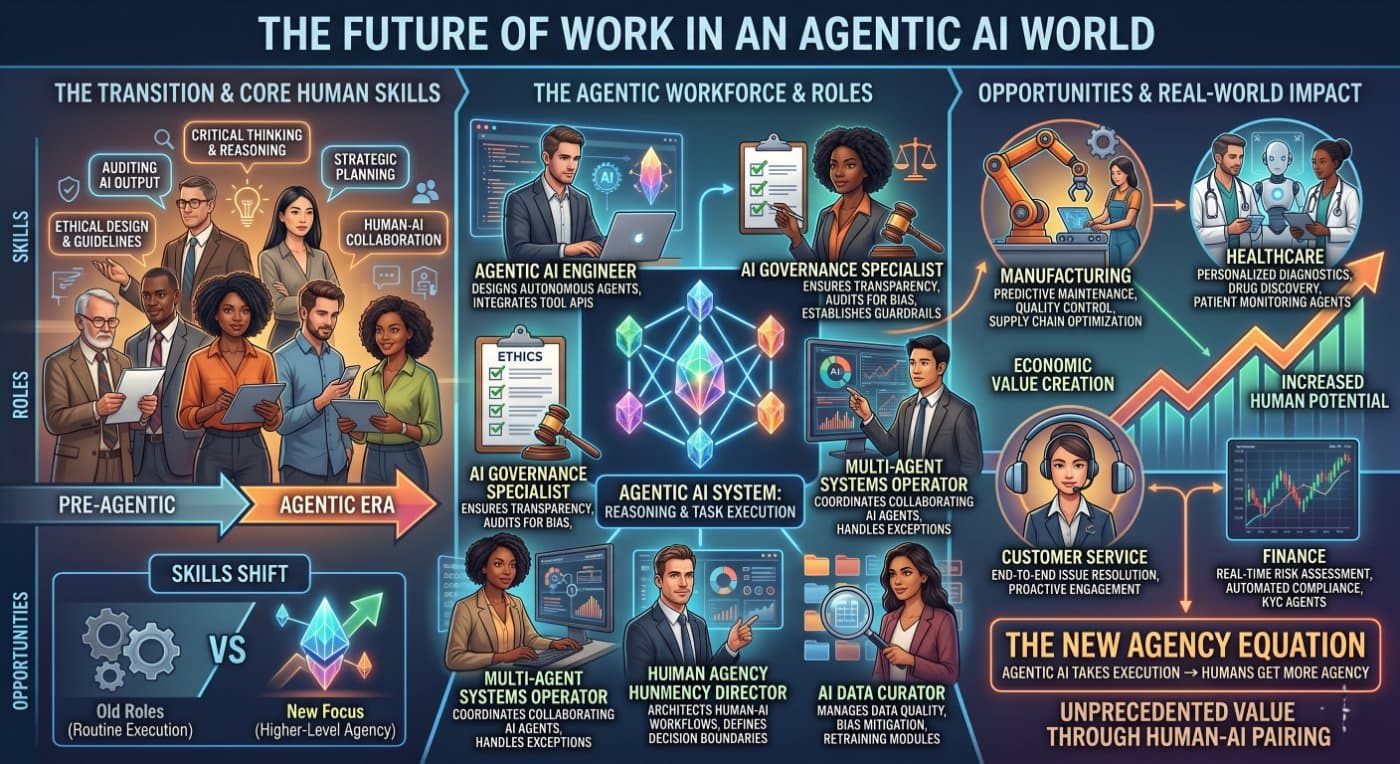
The Future of Work in an Agentic AI World: Skills, Roles, and Opportunities
We are entering a period of profound transformation in how work gets done, who does it, and what the most valuable human contributions look like. Agentic AI systems that can plan, act, and complete complex multi-step tasks autonomously is not just another productivity tool. It is a restructuring force, comparable in scope to the industrial revolution, though compressed into years rather than decades. Understanding what this means for your career and your organization is one of the most important things you can do right now.
The New Shape of Knowledge Work
In an agentic AI world, knowledge workers will spend less time doing and more time directing, evaluating, and deciding. The lawyer will spend less time reviewing documents and more time on strategy and client relationships. The marketer will spend less time writing copy and more time on audience understanding and campaign architecture. The analyst will spend less time crunching numbers and more time on interpretation and recommendation. The human role shifts up the value chain toward the work that requires genuine judgment, creativity, and accountability.
New Roles Emerging Right Now
01 AI Product Manager: Defines what AI systems should do, translates business requirements into AI system specifications, and owns the performance and governance of AI products. One of the fastest-growing roles in tech.
02 Prompt Engineer / AI Interaction Designer: Designs the instructions, workflows, and interaction patterns that make AI systems maximally useful for specific use cases. Part designer, part linguist, part domain expert.
03 AI Trainer / RLHF Specialist: Provides the human feedback that teaches AI models to behave better. As models become more important, the quality of training signals becomes ever more critical.
04 AI Auditor / Ethics Reviewer: Evaluates AI systems for bias, accuracy, fairness, and compliance. As AI regulation increases globally, demand for this role will grow substantially.
05 Agent Architect: Designs multi-agent systems: determines which tasks each agent handles, how agents communicate, where human checkpoints sit, and how the overall system achieves complex organizational goals.
The Skills That Will Define the Next Decade
Critical AI Evaluation The ability to assess AI outputs for accuracy, bias, and appropriateness. As AI generates more of our content and decisions, the ability to evaluate rather than blindly accept becomes critical. Human-AI Collaboration The ability to work effectively with AI tools knowing when to use them, how to prompt them well, how to interpret their outputs, and when to override them. Systems Thinking As agentic AI automates task-level execution, the humans who design the systems who understand how tasks fit into processes, how processes fit into strategies become disproportionately valuable. Interpersonal Leadership Motivation, mentorship, negotiation, and cultural leadership everything that requires genuine human connection becomes more valuable as AI handles more of the transactional and analytical work.
The Organizations That Will Thrive
The organizations that will lead in the agentic AI era share certain characteristics: they invest in AI literacy for their entire workforce, not just their technology teams; they experiment with agentic automation systematically rather than sporadically; they build governance frameworks before they need them; and they focus on what AI enables their people to do, rather than purely on how many people AI can replace. The organizations treating AI as a headcount reduction tool will find short-term savings and long-term competitive disadvantage. Those treating it as a capability multiplier will find the opposite.
"The future belongs not to those who fear AI, nor to those who blindly embrace it, but to those who understand it well enough to direct it wisely toward genuine human flourishing."
Your Next Step
The agentic AI revolution is not coming it is here. The gap between the AI-literate and the AI-resistant is already measurable in productivity, opportunity, and income. The good news is that the tools, training programs, and communities for developing AI literacy have never been more accessible. The AI training program you are engaged with right now is exactly the right investment for exactly the right moment. What you learn here, and how you apply it, will shape the trajectory of your career in ways that compound over years and decades.
Start today. The intelligence horizon is not a threat to navigate around it is an opportunity to move toward, with knowledge, intention, and the confidence that comes from genuine understanding.
Final thought: Every major technological revolution created more opportunity than it destroyed for the people who engaged with it. Artificial intelligence is no different. The question is not whether the transformation is coming. It is whether you will be among those who shape it, or those shaped by it.
Ready to build AI agents yourself?
DSP AI Agent Mastery — self-paced, 16 modules, starts from zero.
Start AI Agent Mastery →